
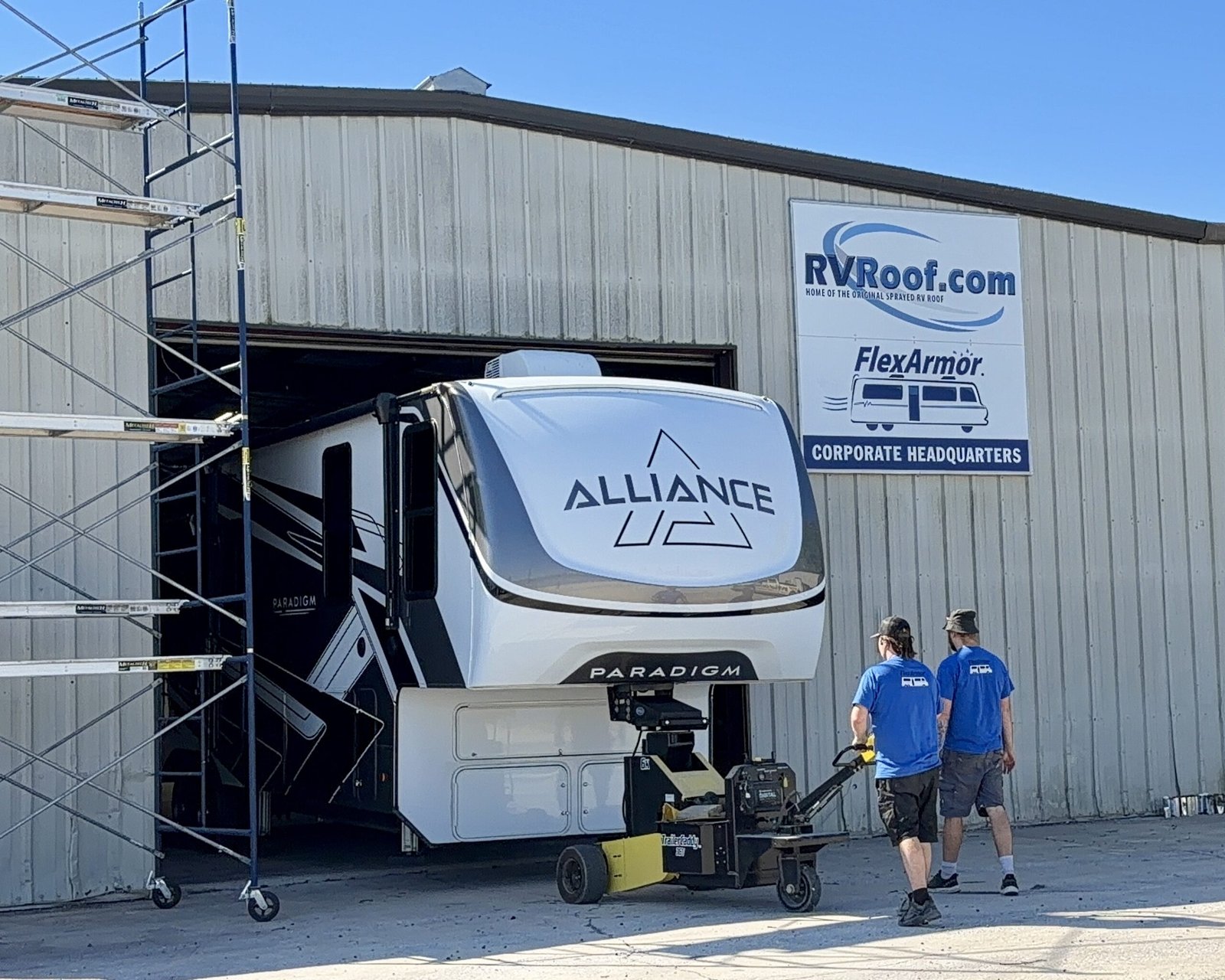
Disclosure: Flex Armor gifted us this roof coating/system so we could test it and share our honest experience. Everything below reflects what we actually saw and heard.
Disclosure: Some links on our site are affiliate links. If you purchase a linked item, we will make a commission, at no extra charge to you.
The roof of an RV is actually one of the things full-timers think about constantly — mostly because a leak is one of the few problems that can turn into a genuine disaster. Water finds its way into wall cavities, subfloors, and insulation long before you ever see a stain, and by the time it’s visible, the damage is often already extensive and expensive. Most RV roofs come with a running list of recommended maintenance — recoating, resealing seams, checking for cracks — that exists entirely to keep that scenario from happening. Skip it, and you’re gambling with the kind of failure that can total a rig. So when the opportunity came up to have Flex Armor RV Roofing install their roof system on our Alliance Paradigm 340RL, the appeal wasn’t just curiosity — it was the idea of removing that risk, and the maintenance treadmill, entirely.
The Install Day
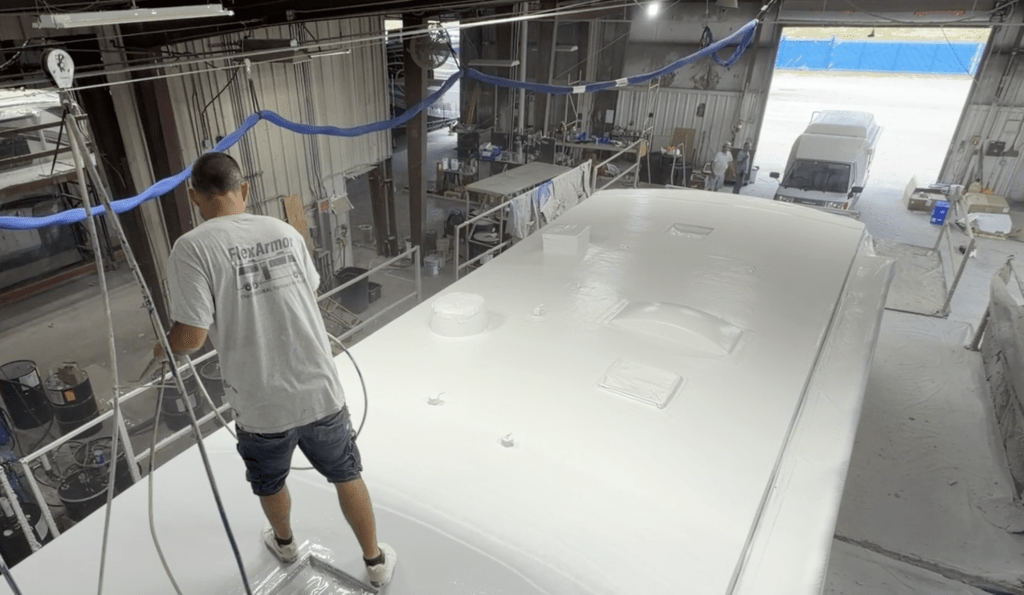
The team from Flex Armor RV Roofing handled the install themselves, which meant we were watching the people who make the product apply it, not a third-party installer working from a manual. The process starts with a full inspection of the existing roof, with any repairs made before anything else happens — ours needed none. From there, everything mounted on the roof comes off: solar panels, AC units, vents, all of it. With the roof stripped down to bare surface, their proprietary coating is sprayed on inside their own garage, then everything that was removed goes back on once it’s cured. We were out of the unit for three days total.
With the reinstall complete, we were back on the road.
What the Owner Told Us
The most useful part of the day wasn’t watching the install — it was the conversation afterward. We sat down with Jennifer, owner of Flex Armor RV Roofing, to get past the marketing copy and into the actual engineering behind the product.
The claim that stuck with us most: a lifetime guarantee against leaks, paired with zero required maintenance. That’s a different promise than what most RV roof coatings make, since the standard advice with EPDM, TPO, or fiberglass roofs is an ongoing cycle of inspection and resealing for as long as you own the rig. Flex Armor tracks every roof they install against that warranty, and it transfers if the rig is ever sold — which matters for resale in a way most roof maintenance never does. The finer points of how the guarantee works are worth hearing straight from the source, so we’ll point you to the video for that part of the conversation.
Two other details came up that we hadn’t expected: the roof is quieter in rain, and more reflective to the sun. Neither of those is the headline pitch for a roof coating, but they’re the kind of thing you notice immediately once you’re back on the road.
Living With It
We’re not going to pretend three days and a fresh install tells you everything about a product built to last the life of the rig. That’s not how roofs work, and it’s not how honest reviews work either. We’ll keep an eye on it and update as the miles add up — good or bad. That’s the deal we make with anything gifted for testing: we say what we actually see, not just what looks good on camera.
The Bigger Picture
Full-time RV life has a way of teaching you which parts of the rig actually matter. You can ignore a lot of cosmetic wear and tear, but the roof isn’t one of the things you get to be casual about. It’s the barrier between “minor repair” and “total loss,” and every full-timer we’ve talked to over the years has a roof story — usually not a good one.
If you’re considering a roof upgrade or recoat yourself, our advice is the same regardless of brand: get a professional assessment of your current roof condition first, understand what your existing material is (EPDM, TPO, fiberglass, metal) since not every coating is compatible with every roof type, and ask hard questions about long-term data, not just marketing language.
We’ll have more to share on how the Flex Armor roof performs as the miles add up. For now — full video of the install and interview is up on our YouTube channel, if you want to see it for yourself.
Flex Armor provided this product to Fitting In Adventure at no cost for testing and review purposes. We were not paid for this post, and all opinions are our own.

Vince DiLoreto spent 20 years in the United States Air Force seeing the world before deciding to see it properly — this time with a camera, an RV, and considerably better food. A trained photographer and the visual half of Fitting in Adventure, Vince captures the places, people, and moments that make every trip worth telling. When he’s not behind the lens, he’s behind the wheel, which means he’s seen every gas station between Florida and the Pacific Northwest.