
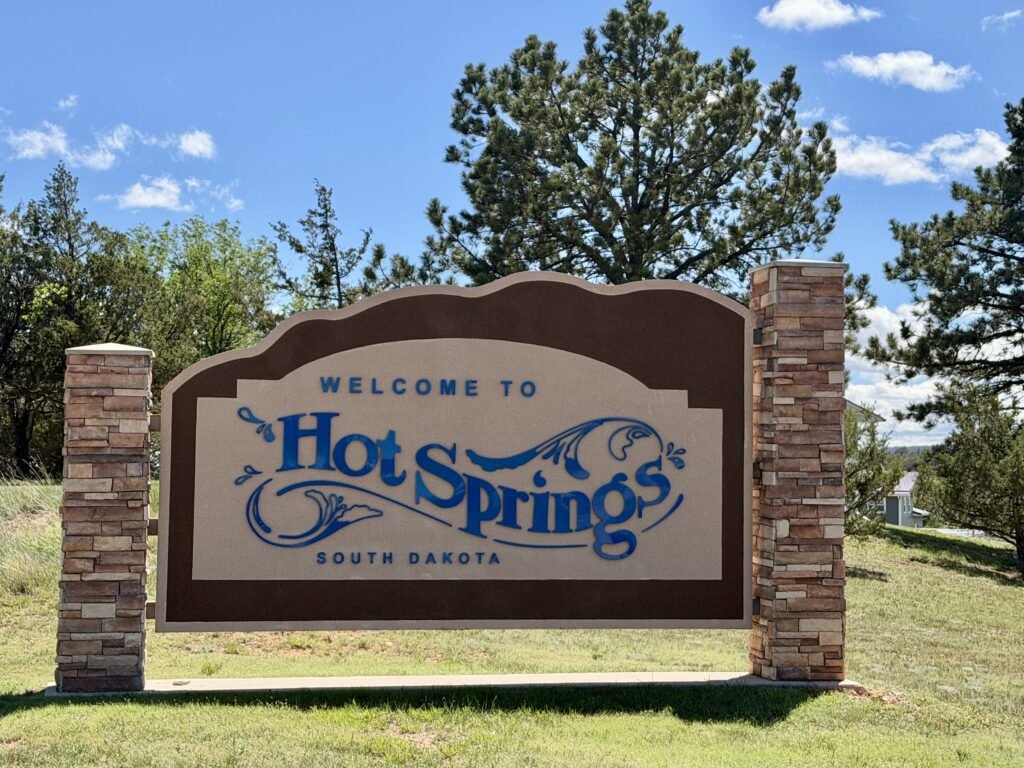
Most travelers who visit the southern Black Hills treat Hot Springs as a logistics hub — a place to sleep and fuel up between Wind Cave and Custer State Park. That’s understandable, and it means the downtown tends to get about twenty minutes of attention before people head back to the campground.
Disclosure: Some links on our site are affiliate links. If you purchase a linked item, we will make a commission, at no extra charge to you.
Give it an afternoon instead.
Hot Springs’ downtown is built almost entirely from locally quarried sandstone — a warm pink-tan stone that gives the entire main street a cohesive, visually distinctive look that has nothing to do with aesthetic renovation and everything to do with the fact that the stone was cheap and local in the 1880s when the town was being built. The buildings that went up then are mostly still standing, which is unusual for a town this size in this part of the West. Walking through it feels less like a preserved historic district and more like a place that simply never had reason to tear itself down.
Quick Answer: Downtown Hot Springs and Evans Plunge
Downtown Hot Springs is a compact historic commercial district built primarily from locally quarried sandstone in the 1880s–1900s. Evans Plunge Mineral Springs is one of the oldest natural indoor swimming pools in the United States, fed by warm mineral springs that flow at 87°F year-round.
- Best for: History travelers, architecture enthusiasts, families wanting a relaxed day, anyone needing a break from cave tours and wildlife drives
- Time needed: 2–4 hours for downtown and Evans Plunge combined
- Downtown: Free to walk; parking is easy and manageable
🕑 Evans Plunge hours vary significantly by season. Confirm current hours before visiting.
The Sandstone Architecture: Why It Looks the Way It Does
Hot Springs was platted in 1879 and incorporated in 1882, during a period when the town was positioning itself as a health resort for travelers who believed the warm mineral springs had therapeutic properties. The development money paid for buildings, and the buildings were made from what was available: sandstone from the Burke quarry just outside town.
The Burke quarry stone ranges from warm tan to deep pink depending on the light and the specific block. Buildings constructed from it have a texture and color that’s immediately identifiable once you know what you’re looking at, and in Hot Springs almost everything significant was built from it — the commercial storefronts, the bathhouses, the 1893 schoolhouse that now houses the Pioneer Museum on the hill above town. The result is a streetscape with an unusual visual coherence that most small western towns don’t have.
Walking the main commercial blocks, it’s worth slowing down enough to actually look at the buildings rather than through them. The stonework on the older structures is detailed in ways you miss at walking pace.
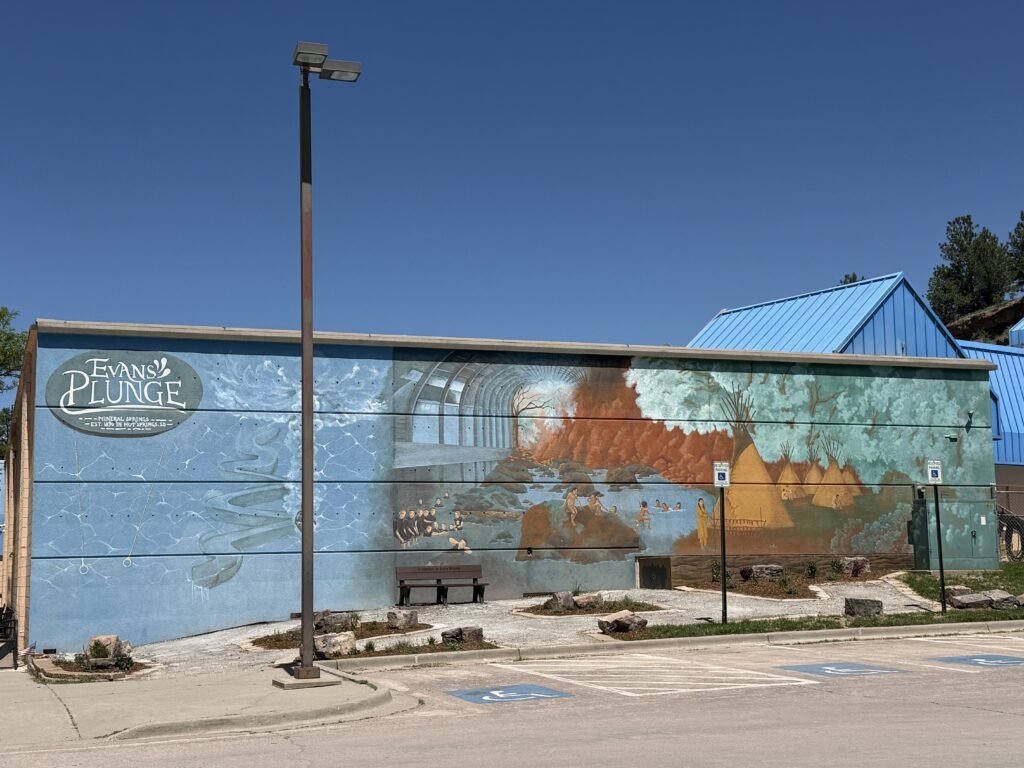
Evans Plunge Mineral Springs
Evans Plunge has been operating in some form since 1890, fed by warm springs that produce water at a constant 87 degrees Fahrenheit year-round. It’s described as one of the oldest natural warm-water indoor swimming facilities in the United States, and it has evolved considerably from its original bathhouse configuration.
⚠ PLACEHOLDER — Did not visit on this trip — add real detail after visit, or note in copy that it’s a recommended stop based on research and local reputation
What’s historically significant is the continuity: the same springs that drew health tourists to Hot Springs in the 1880s are still producing water at the same temperature today, feeding a facility that has operated continuously for well over a century.
🕑 Evans Plunge hours vary significantly by season. Confirm current hours before visiting.
Where to Eat in Downtown Hot Springs
Jalapeños handles the practical question of where to eat after a long day in the field. It’s on the main commercial strip, the portions are real, and the taco salads and burritos are both solid. After a full day at Wind Cave or the Mammoth Site, it’s a reliable choice that does exactly what it’s supposed to.
Two Cows Creamery is a different category. This is house-made ice cream with a short, well-considered menu. We went back twice — the sweet cream came recommended by another guest at the counter, and it was the right call; the Mexican chocolate on a second visit was equally good. Fresh ice cream reads differently than commercial brands, and in a town with limited options, this stands out as the kind of stop that earns a separate visit rather than just a mention in a list.
🕑 Two Cows Creamery operates seasonally. Confirm current hours before visiting.
How to Structure a Hot Springs Afternoon
The downtown is compact enough to walk thoroughly in about an hour. A reasonable sequence: park near the main commercial blocks, walk the sandstone streets, stop at Two Cows for ice cream, then either visit Evans Plunge or walk up to the Pioneer Museum on the hill above town. The Pioneer Museum closes seasonally — check hours before building it into the afternoon. See our [Fall River Pioneer Museum guide] for what to expect inside.
For the full basecamp picture, read our [Hot Springs, South Dakota basecamp guide].
Planning Tips
- Downtown parking is available and easy
- The Pioneer Museum is a short uphill walk from downtown
- Jalapeños is a reliable dinner option after full park days; no reservations needed
🕑 Evans Plunge hours vary significantly by season — check before visiting, especially shoulder season. Confirm current hours before visiting.
🕑 Two Cows Creamery and the Pioneer Museum both operate seasonally. Confirm current hours before visiting.
Little-Known Facts
- The warm springs in Hot Springs flow at a consistent 87 degrees Fahrenheit year-round, making Evans Plunge usable in all seasons.
- Hot Springs was marketed as a health resort to wealthy travelers from the Midwest and East Coast during the 1880s and 1890s.
- The Burlington and Missouri River Railroad reached Hot Springs in 1891, accelerating the resort development boom.
- The Fall River, which runs through the lower part of downtown, is fed partially by the same warm spring system that supplies Evans Plunge.
- Hot Springs served as the county seat of Fall River County from the town’s incorporation in 1882.
Is downtown Hot Springs worth visiting?
Yes, particularly for travelers who appreciate historic architecture. The sandstone commercial district is unusually intact and visually distinctive. Combined with Evans Plunge and the Pioneer Museum, it makes for a full, low-mileage afternoon.
What is Evans Plunge?
Evans Plunge Mineral Springs is a natural warm-water swimming facility in Hot Springs, SD, fed by springs that flow at 87°F year-round. It has operated continuously since 1890, making it one of the oldest mineral spring facilities in the United States.
Is Evans Plunge open year-round?
Hours vary by season. Confirm current hours before visiting, especially outside the summer peak.
What are the best restaurants in downtown Hot Springs?
Jalapeños is reliable for a solid meal after a long day out. Two Cows Creamery is the standout stop for fresh house-made ice cream and is worth a separate visit.
Is Hot Springs, SD walkable?
Yes. The commercial downtown is compact and easily walked in about an hour. Evans Plunge and the Pioneer Museum are both within a short distance of the main commercial blocks.
What is the sandstone architecture in downtown Hot Springs?
Most of the downtown commercial buildings were constructed from locally quarried Burke quarry sandstone during the town’s 1880s–1900s development boom. The warm pink-tan stone gives the district a visual cohesion unusual for a town this size.
Hot Springs’ downtown doesn’t announce itself. The sandstone is just there, the way stone buildings in old towns tend to be — present without explanation, consistent enough that you only notice the logic of it once you’ve been walking the streets for a few minutes. The ice cream at Two Cows is a harder-to-miss detail. Both are worth more than the twenty minutes most visitors give them.
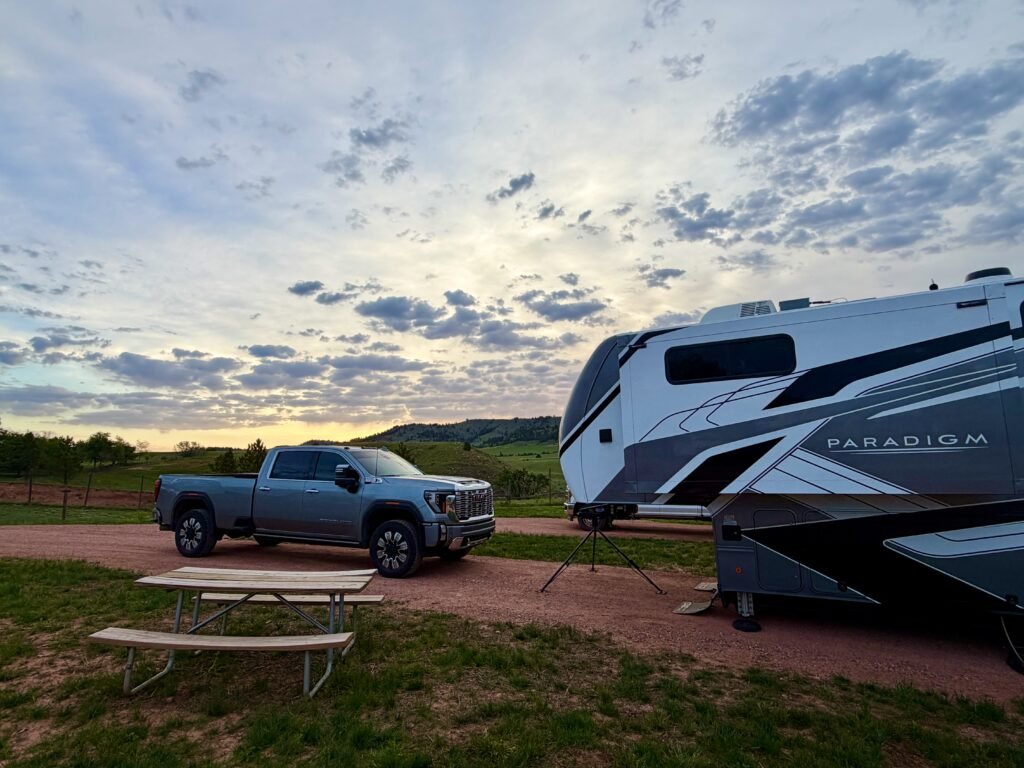
Where We Stayed
We based our Hot Springs trip out of Sunrise Ridge Campground in Hot Springs, South Dakota — about 25 to 40 minutes from most of the stops in this guide. Level sites, quiet property, and there’s a small petting zoo on-site if you’re traveling with kids.
This was a complimentary stay in exchange for coverage. All opinions are our own.
Vince DiLoreto spent 20 years in the United States Air Force seeing the world before deciding to see it properly — this time with a camera, an RV, and considerably better food. A trained photographer and the visual half of Fitting in Adventure, Vince captures the places, people, and moments that make every trip worth telling. When he’s not behind the lens, he’s behind the wheel, which means he’s seen every gas station between Florida and the Pacific Northwest.