
On May 31, 1834, William Sublette laid the foundation log for a trading post at the confluence of the Laramie and North Platte Rivers, then left his partner Robert Campbell behind with thirteen men to finish building it while he pushed on to that year’s rendezvous. Passing the same spot days later, a missionary named Jason Lee noted in his diary that some of Sublette’s men were “planting corn” beside their half-built stockade — a strange, domestic detail for a fort in the middle of what was then still Indian country, hundreds of miles from the nearest American town.
Disclosure: Some links on our site are affiliate links. If you purchase a linked item, we will make a commission, at no extra charge to you.
That fort — Fort William, later Fort Laramie — became the most important waypoint on the entire overland trail for the next fifty years. But the ground it sat on had already been a crossing point long before Sublette ever arrived, and it stayed one long after the fort itself was decommissioned in 1890. The five stops in this guide are what’s left of that corridor: a spire that told emigrants they were on the right track, a wall of bluffs they had to route around, a fort that resupplied nearly every wagon party that passed through, and two places — a rock wall and a stretch of solid sandstone — where the sheer number of people who came through actually changed the land itself.
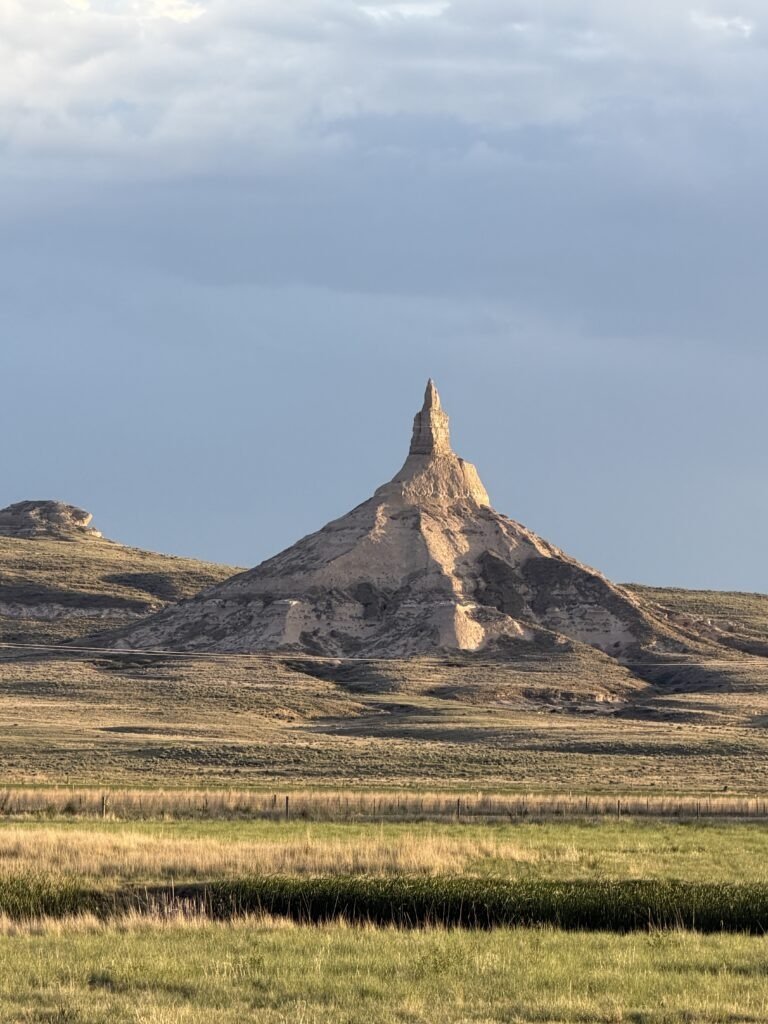
Chimney Rock National Historic Site
If any single landmark defines the Oregon Trail in popular memory, it’s this one. Rising roughly 300 feet above the valley floor near Bayard, Nebraska, Chimney Rock was the most-mentioned landmark in surviving emigrant diaries — more than any other point on the entire trail. Fur traders were already writing about its shape in the 1820s, and for the wagon parties who followed, spotting it on the horizon meant the flat, easy stretch of the journey was ending and the mountain phase was about to begin.
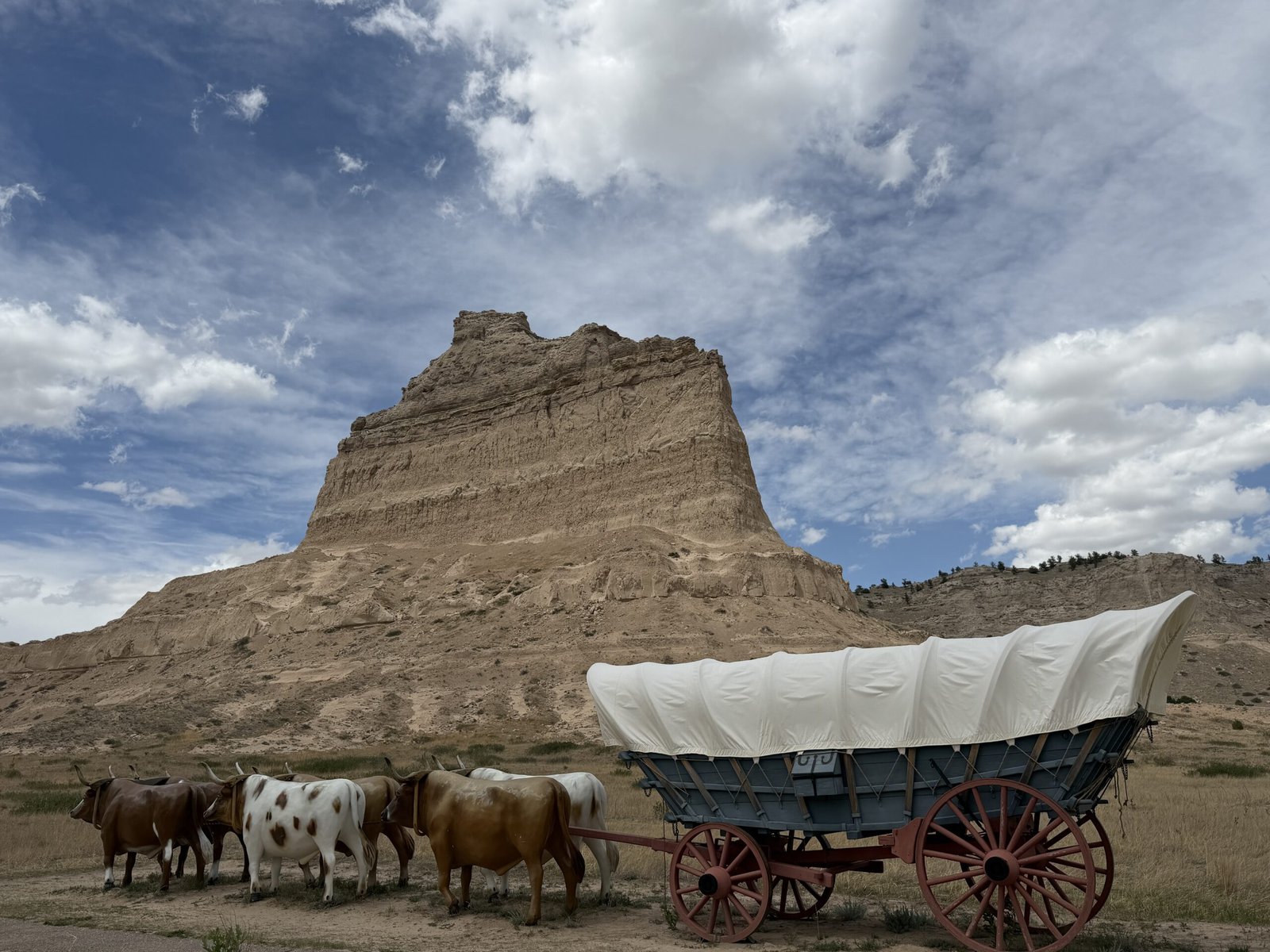
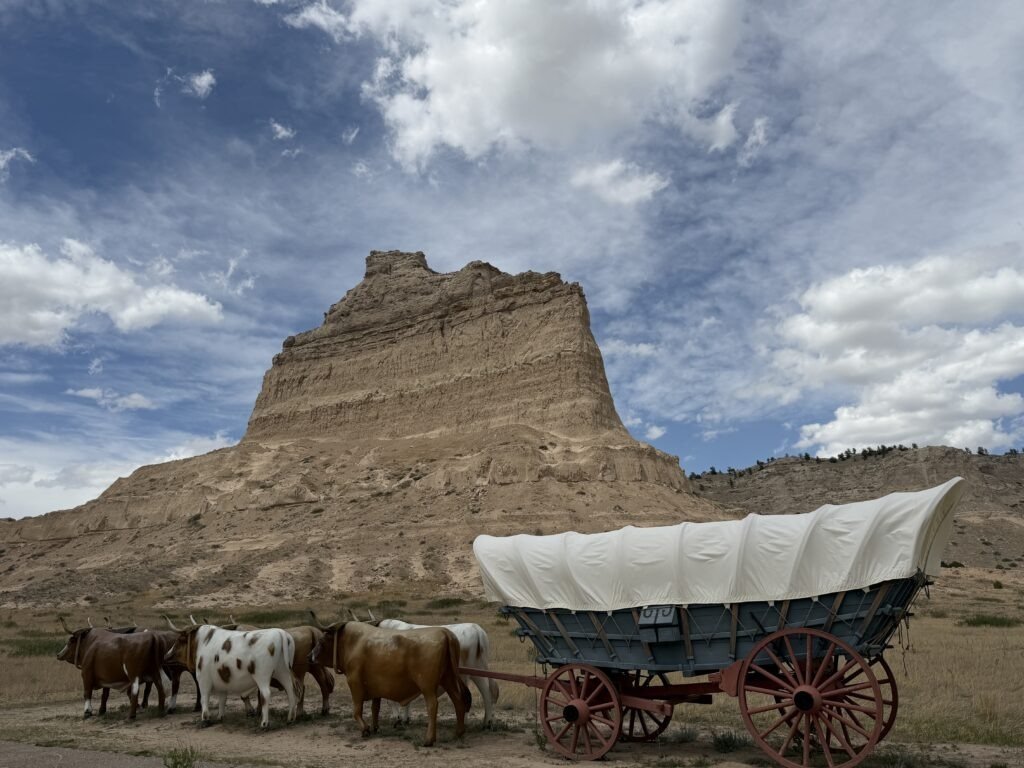
Scotts Bluff National Monument
About twenty minutes southwest of Chimney Rock, Scotts Bluff is the trail’s first real gateway — a wall of eroded bluffs that emigrants had to route around via Mitchell Pass rather than over. It’s an easy add-on to a Chimney Rock stop, and the two together give a sense of just how much this stretch of the trail was shaped by terrain rather than distance.
Fort Laramie National Historic Site
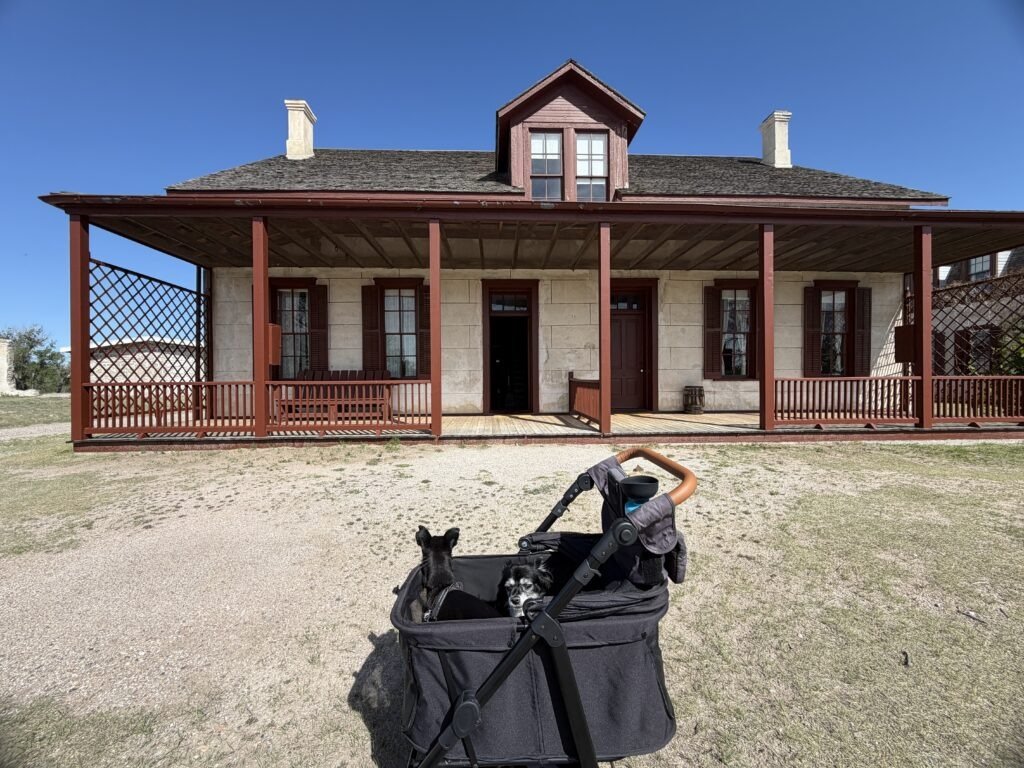
This is the stop worth giving the most time. What started as Sublette and Campbell’s 1834 trading post became the largest and best-known military post on the Northern Plains, and for decades it functioned as the trail’s essential resupply hub — nearly every westbound party passed through. Twenty-two original structures are still standing, including Old Bedlam, built in 1849 and considered the oldest military building still standing in Wyoming.
Gracie and Loki came along for this one, and it’s where they picked up their Bark Ranger badges — the National Park Service’s program for dogs, built around four principles that stay the same at every park that runs it: bag your pet’s waste, always leash your pet, respect wildlife, and know where you can go. A ranger walked them through the principles before handing over the badge itself, a small tag that clips to the collar and is stamped with the park’s name.
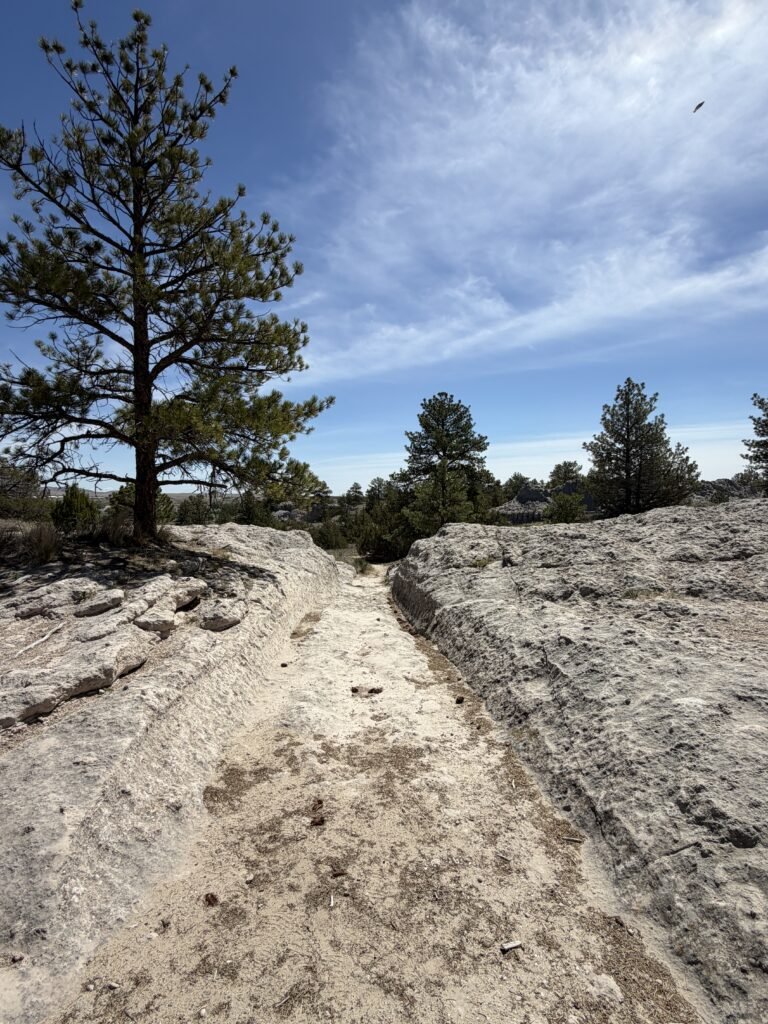
Guernsey Ruts (Oregon Trail Ruts State Historic Site)
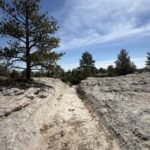
From Fort Laramie, it’s a short drive north to Guernsey, home to what might be the single most tangible piece of trail history anywhere on the route: wagon wheel ruts worn several feet deep into solid sandstone — nearly five feet down in some sections, deep enough that the ground drops away at eye level rather than underfoot. What actually lands, standing at the edge of them, is the math — the sheer number of wagons and people it took to grind a permanent scar into rock, at a narrow point where every party funneled through the same few feet of ground. The ruts also make the route itself visible in a way maps don’t: you can see exactly how the trail weaved and bent based on where the ground allowed it, cutting toward Register Cliff a few miles on. It reframes the whole crossing — less a straight line west and more a path that fought the landscape the entire way.
The path in from the parking area is paved but climbs steeply in places — more of a climb than a flat walk. Visited on a clear, sunny day with nothing else notable to flag.
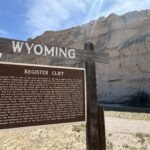
Register Cliff
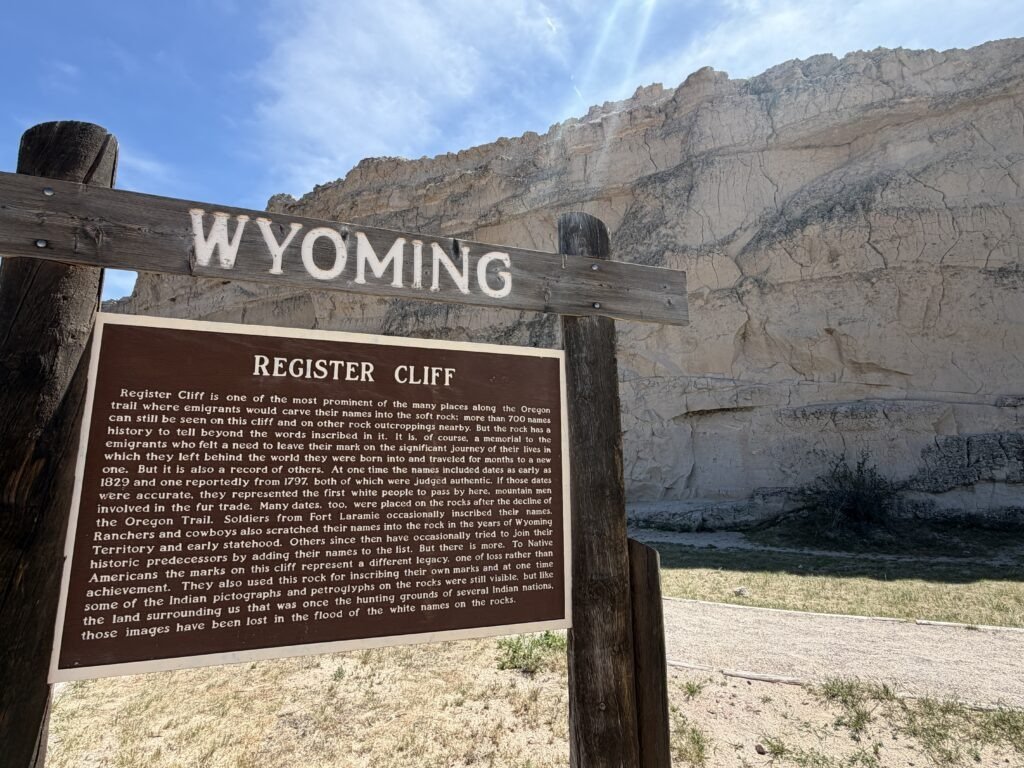
A few miles from the ruts, Register Cliff is where emigrants carved their names directly into a soft sandstone bluff as they passed through — a 19th-century guestbook, and one of the few spots on the trail where you can see individual travelers’ names rather than just reading about them secondhand. The dogs made this stop too. Carving new names into the rock is no longer permitted.
Basecamp and RV Notes
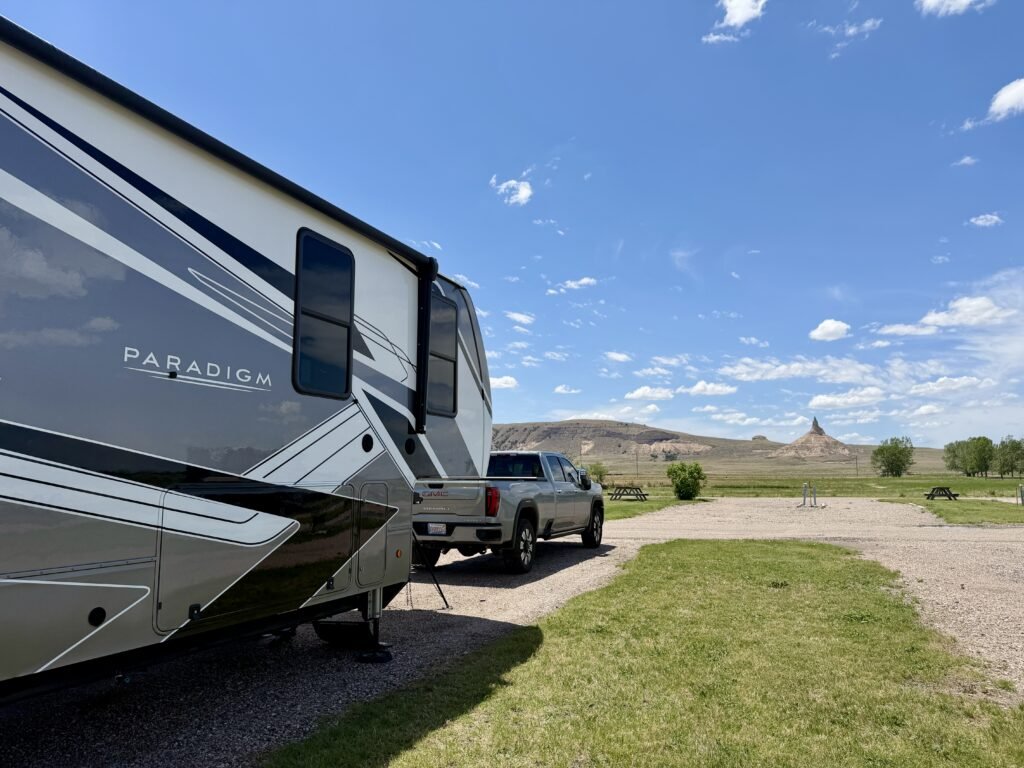
All five stops were run as day trips from a single basecamp: Chimney Rock Pioneer Crossing RV Park in Bayard, Nebraska, which sits at the base of Chimney Rock itself. The park offers full hookups and an on-site dump station, with check-in through the attached Settlers Trading Post. From there, Scotts Bluff is about 20-25 minutes away, Fort Laramie is roughly an hour further west across the Wyoming line, and Guernsey Ruts and Register Cliff are a few minutes past that — close enough to treat the whole corridor as a single basecamp rather than needing to move sites partway through.
The one hard rig restriction on this route is Scotts Bluff’s Summit Road: vehicles over 25 feet long or 11’7″ tall are prohibited, and trailers aren’t allowed on it at all. Anyone towing will want to leave the trailer at the visitor center lot before continuing up, or hike the paved Saddle Rock Trail instead. Fort Laramie, Guernsey Ruts, and Register Cliff all have standard parking with no notable size restrictions.
Planning the Route
Driving the corridor west to east or east to west, the order in this guide is the one that actually makes sense on the ground: Chimney Rock, then Scotts Bluff, then Fort Laramie, then Guernsey Ruts, then Register Cliff. All five stops were visited in person for this guide.
What order should I visit these Oregon Trail stops in?
Chimney Rock, then Scotts Bluff, then Fort Laramie, then Guernsey Ruts, then Register Cliff — this follows the actual trail route and driving distances between stops.
How much time should I plan for all five stops?
A full day covers all five comfortably, or split across two days if you want time to walk each site rather than just view it from the parking area. Fort Laramie alone is worth two to three hours.
Are dogs allowed at these sites?
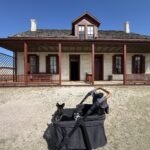
Yes — leashed dogs were welcome at all five stops when we visited, and Fort Laramie runs a Bark Ranger program where dogs can earn a badge by following the B.A.R.K. principles: bag waste, always leash, respect wildlife, know where you can go.
Is this route RV-friendly?
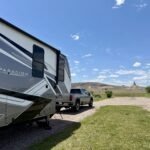
Yes, with one exception: Scotts Bluff’s Summit Road prohibits vehicles over 25 feet or 11’7″ tall, and trailers aren’t allowed on it at all. Everything else has ample parking for larger rigs.
Where’s a good basecamp for this route?
Chimney Rock Pioneer Crossing RV Park in Bayard, Nebraska works as a single basecamp for all five stops — full hookups, an on-site dump station, and within reach of every site on this list.
Which of these stops are free to visit?
Fort Laramie, Scotts Bluff, Guernsey Ruts, and Register Cliff have no entrance fee. Chimney Rock’s visitor center charges a small admission fee, though the trail itself can be accessed for free from a trailhead parking lot past the visitor center.

Angela DiLoreto is a bestselling author, former Fortune 500 marketing executive, and a passionate advocate who successfully worked to change stalking laws in several states after a family friend was murdered by her stalker. That fight — for justice, for voices that weren’t being heard, for stories that needed to be told — runs through everything she does. She and her husband Vince travel the country by RV with their two rescue chihuahuas, Gracie and Loki, chasing history, great food, and the overlooked people and places that shaped America. Angela created Fitting in Adventure and the Historic Footnotes series because the best stories are usually the ones nobody’s heard yet.