
In 1943, the United States built three cities that didn’t exist.
Disclosure: Some links on our site are affiliate links. If you purchase a linked item, we will make a commission, at no extra charge to you.
Oak Ridge, Tennessee materialized in the forested hills of the Cumberland Plateau — 75,000 people, schools, hospitals, a bus system, a recreation center, none of it on any map, none of it accessible without a security badge. Los Alamos, New Mexico appeared on a remote mesa in the Jemez Mountains, reachable by a single road and surrounded by 40 miles of wilderness, home to the most concentrated assembly of scientific genius in history. Hanford, Washington rose in the high desert of the Columbia River basin, its true purpose unknown to most of the people building it.
The workers in these cities knew they were doing something important. Most of them didn’t know what. That was the point.
What they were doing was building the atomic bomb, in a project of such scale and such secrecy that it employed 130,000 people, spent the equivalent of $30 billion in today’s money, and remained largely unknown to the American public — and to most of the American government — for three years. Harry Truman, as Vice President, had no idea it existed until Franklin Roosevelt died and he was briefed as the new Commander in Chief.
The science was extraordinary. The secrecy was equally extraordinary. And the weight of what both of them produced is something you don’t fully understand until you stand at Trinity Site in the New Mexico desert, in the place where it all became real.
The Scale of the Secret
The Manhattan Project was organized on a principle of strict compartmentalization. Each worker knew only what they needed to know to do their specific job — and nothing more. The women operating the electromagnetic separation calutrons at Oak Ridge’s Y-12 plant knew they were adjusting dials and monitoring equipment. They did not know they were separating uranium isotopes. They did not know there was uranium involved. They knew their dials and their shift schedules and their security badges.
The three primary sites communicated through a network of couriers carrying information that no single facility held in full. J. Robert Oppenheimer at Los Alamos was one of the very few people with visibility across the entire project. Even among the scientists, information moved on a strict need-to-know basis, which meant that brilliant people working on individual components of the bomb sometimes didn’t fully understand what they were building until it was built.
Security was pervasive and, by later accounts, occasionally darkly comic. Mail was opened and read. Conversations were monitored. One Oak Ridge worker was followed by a security agent for an entire day after mentioning to a coworker that her work involved ‘a process that separates things.’ She had revealed nothing classified. The agent followed her anyway.
The secret held for three years across three states with 130,000 people. Nothing equivalent, before or since, has been kept at that scale for that duration. It remains one of the most remarkable feats of information control in the history of organized human endeavor.
The Science: What They Were Actually Building
The practical challenge of the Manhattan Project was this: take a theoretical understanding of nuclear fission that had existed for fewer than five years and turn it into a working weapon, faster than Nazi Germany could do the same thing.
Nuclear fission — the splitting of atomic nuclei to release enormous energy — had been confirmed by German physicists in December 1938. The implications were immediately understood by physicists across the world, including several who had fled Nazi Germany and were now working in the United States. The race that followed was the most consequential scientific competition in history.
Oak Ridge existed to solve the enrichment problem. Natural uranium is 99.3% U-238, which does not sustain a fission chain reaction. Only U-235 — 0.7% of natural uranium — is fissile enough to work. Separating U-235 from U-238 at the quantities needed required three different methods running simultaneously, because no one was certain which would work. The electromagnetic separation plants used magnets so large they stripped the nation’s wartime copper supply, requiring the Treasury Department to loan 14,700 tons of silver for the electromagnets’ windings.
Hanford produced plutonium in the world’s first full-scale nuclear reactors. Los Alamos took what Oak Ridge and Hanford produced and turned it into weapons. Oppenheimer’s team was designing the bomb while the other two sites were still building the material to put inside it.
Los Alamos: The City on the Mesa
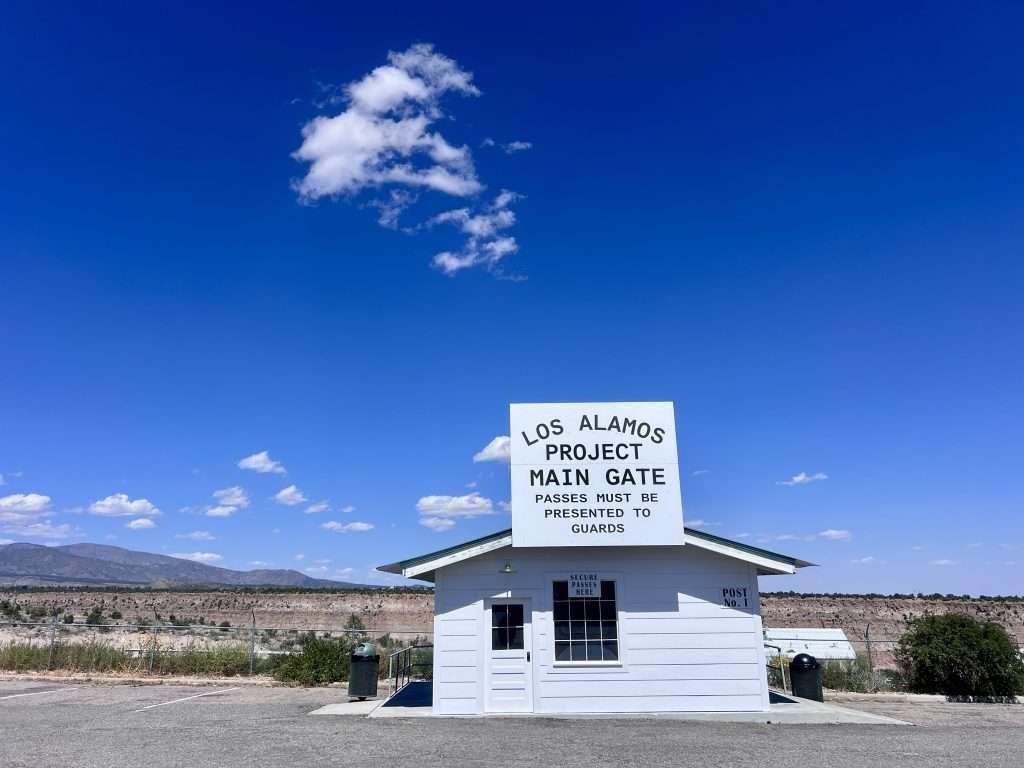
Los Alamos sits on a mesa in the Jemez Mountains of northern New Mexico, 35 miles northwest of Santa Fe. The laboratory — Los Alamos National Laboratory — still operates as a nuclear research facility. The town that was built here in 1943 has grown and changed, but its bones are still the bones of the secret city.
The Bradbury Science Museum in downtown Los Alamos is operated by the laboratory itself and covers the project’s history with candor that is sometimes surprising. The science, the secrecy, the moral debates that surrounded the decision to use the bomb, the aftermath — it is all addressed. The collection includes actual weapon components, historical photographs, and documentary material that gives you a genuine sense of both what was achieved and what it cost.
Fuller Lodge, the original dining hall of the Los Alamos Ranch School that occupied the mesa before the government requisitioned it, still stands and is open to the public. Walking the streets of the original townsite, where Oppenheimer and Fermi and Bohr walked, is one of those quiet historic experiences that doesn’t announce itself.
Uncover New Mexico’s Manhattan Project Sites
Oak Ridge: The Secret City That Built the Bomb
Oak Ridge was the largest of the Manhattan Project’s secret cities and the one whose purpose was most completely hidden from its own population. When the bomb was dropped on Hiroshima on August 6, 1945, Oak Ridge residents learned what they had been doing from the newspaper, along with everyone else.
The American Museum of Science and Energy covers both the Manhattan Project history and the broader story of nuclear energy with depth and honesty. The Y-12 History Center, on the grounds of the still-operating Y-12 National Security Complex, covers the electromagnetic separation work in remarkable detail. Driving through the original townsite — the residential areas, the original high school, the recreation facilities built to keep 75,000 people functional and secret — gives you a physical sense of the scale of what was assembled here and how completely ordinary daily life inside it was made to feel.
Exploring Oak Ridge: Secrets of the Manhattan Project
Trinity Site: Where the Weight Lands
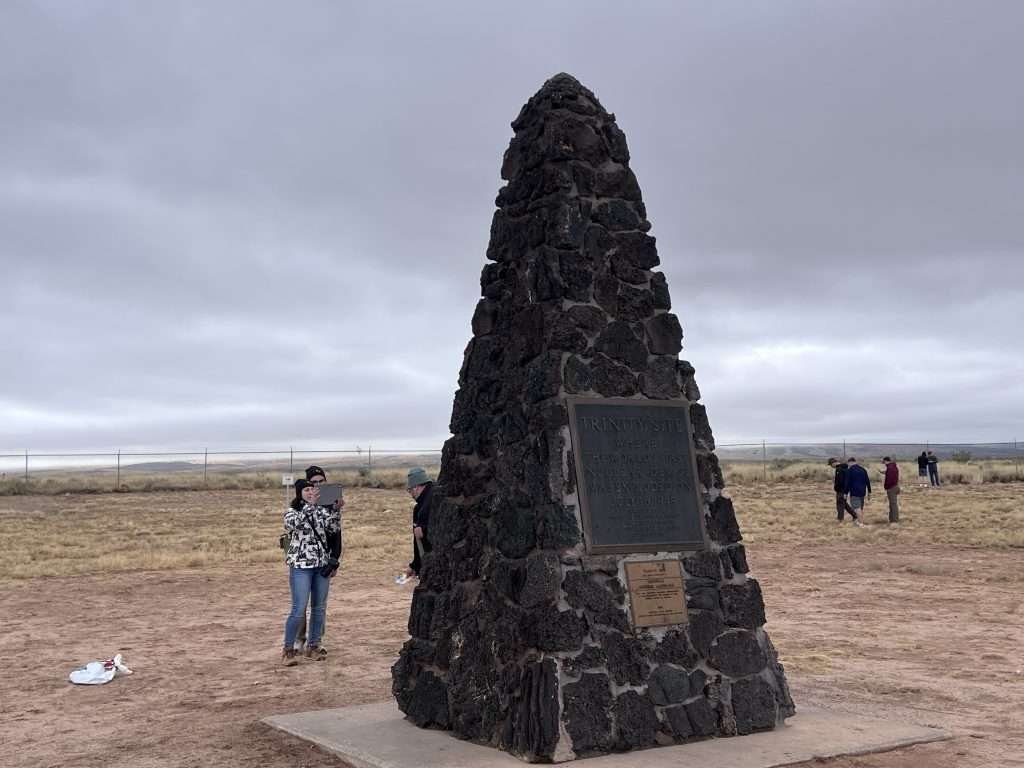
Everything else in the Manhattan Project is about the science — the extraordinary achievement of building something that had never existed, faster than anyone thought possible, in secret cities that appeared from nothing. Trinity is where the science became something else.
On July 16, 1945, at 5:29 in the morning, the first atomic bomb detonated at the Trinity Site in the Jornada del Muerto desert of New Mexico — the Journey of the Dead Man, named by Spanish colonists three centuries earlier. The explosion was visible 250 miles away. The shock wave was felt 100 miles away. The sand beneath the tower fused into a pale green glass that scientists named trinitite. Oppenheimer recalled the Bhagavad Gita: ‘Now I am become Death, the destroyer of worlds.’
Trinity Site is open to the public once per year, on the first Saturday of October. It is located on White Sands Missile Range, and visitors drive through the active military installation to reach it. The ground zero marker, the reconstructed base of the detonation tower, and the McDonald Ranch House — where the bomb’s plutonium core was assembled in the days before the test — are all accessible during the open day.
Standing at the marker, looking at the desert that absorbed the first atomic explosion, the thought-provoking quality of the place arrives quietly and stays. The ranch house is where it gets specific. The rooms where the plutonium core was handled, assembled, and prepared are intact and labeled. Standing in one of them, knowing what was in that room in July 1945, produces the particular feeling of questioning your life choices that only certain historic sites can generate. It is worth every mile of the drive to get there.
What the Scientists Knew
Many of the Manhattan Project’s scientists were not comfortable with what they had built. The original justification — build it before Nazi Germany does — collapsed in May 1945 when Germany surrendered and it became clear that the German nuclear program had never come close. The bomb that remained was now to be used against Japan, which had no equivalent weapon.
The Franck Report, signed by seven senior project scientists in June 1945, argued explicitly against using the bomb on Japanese cities without prior warning. It recommended a demonstration on an uninhabited area, giving Japan the opportunity to surrender before a city was destroyed. It was delivered to the Secretary of War and set aside.
Oppenheimer later said that the scientists had known sin — using the word in its original sense, as knowledge that changes you irrevocably. He believed the project was necessary given what was known in 1943. He did not believe that made the outcome uncomplicated. The sites where the Manhattan Project happened carry both things simultaneously: the achievement and the weight of it. Trinity is where you feel the weight most clearly.
Planning a Visit to the Manhattan Project Sites
Los Alamos: Bradbury Science Museum, 1350 Central Ave, Los Alamos, NM. Free. Open Tuesday-Saturday. Combine with a Santa Fe trip — 35 miles south.
Oak Ridge: American Museum of Science and Energy, 115 Main St E, Oak Ridge, TN. Admission charged. Open Monday-Saturday. Two hours west of Nashville.
Trinity Site: White Sands Missile Range, NM. Open once per year — first Saturday of October. Free admission. Drive through active military base required. Check White Sands Missile Range website for current year date and entry requirements.
Hanford B Reactor: Near Richland, WA. Tours available through the Manhattan Project National Historical Park. Advance reservation required. The most remote and least visited of the major sites.
Can you do all three?: The sites are in New Mexico, Tennessee, and Washington State — not practical as a single trip. Most visitors anchor to one site and build a regional trip around it. Trinity pairs naturally with Los Alamos and a New Mexico itinerary.
Frequently Asked Questions About the Manhattan Project
What was the Manhattan Project?
The Manhattan Project was the top-secret U.S. program, begun in 1942, that developed the first nuclear weapons during World War II. It employed approximately 130,000 people across three primary sites — Los Alamos, New Mexico; Oak Ridge, Tennessee; and Hanford, Washington — and operated in near-total secrecy for three years.
How secret was the Manhattan Project?
The Manhattan Project was organized on strict compartmentalization — each worker knew only what was necessary for their specific task. Most of the 130,000 employees did not know they were working on an atomic bomb. Vice President Harry Truman was unaware of the project until he became president in April 1945. The secret was maintained across three states and 130,000 people for approximately three years.
Can you visit the Trinity Site in New Mexico?
Yes. Trinity Site in White Sands Missile Range, New Mexico, is open to the public once per year on the first Saturday of October. Visitors drive through the active military installation to reach the site. The ground zero marker, reconstructed tower base, and McDonald Ranch House where the bomb’s core was assembled are all accessible. Admission is free.
What is trinitite?
Trinitite is the pale green glass formed when the heat of the Trinity atomic bomb detonation fused the desert sand at the blast site on July 16, 1945. Small amounts remain at the Trinity Site today. Removing trinitite from the site is illegal.
Where can you visit Manhattan Project sites today?
The primary Manhattan Project sites open to visitors are: the Bradbury Science Museum in Los Alamos, New Mexico; the American Museum of Science and Energy in Oak Ridge, Tennessee; the Trinity Site at White Sands Missile Range, New Mexico (open once yearly in October); and the B Reactor at Hanford, Washington (tours available through the Manhattan Project National Historical Park).
Explore the Manhattan Project with Fitting in Adventure
New Mexico’s Manhattan Project Sites: Los Alamos & Trinity Site
Exploring Oak Ridge: Secrets of the Manhattan Project

Angela DiLoreto is a bestselling author, former Fortune 500 marketing executive, and a passionate advocate who successfully worked to change stalking laws in several states after a family friend was murdered by her stalker. That fight — for justice, for voices that weren’t being heard, for stories that needed to be told — runs through everything she does. She and her husband Vince travel the country by RV with their two rescue chihuahuas, Gracie and Loki, chasing history, great food, and the overlooked people and places that shaped America. Angela created Fitting in Adventure and the Historic Footnotes series because the best stories are usually the ones nobody’s heard yet.