
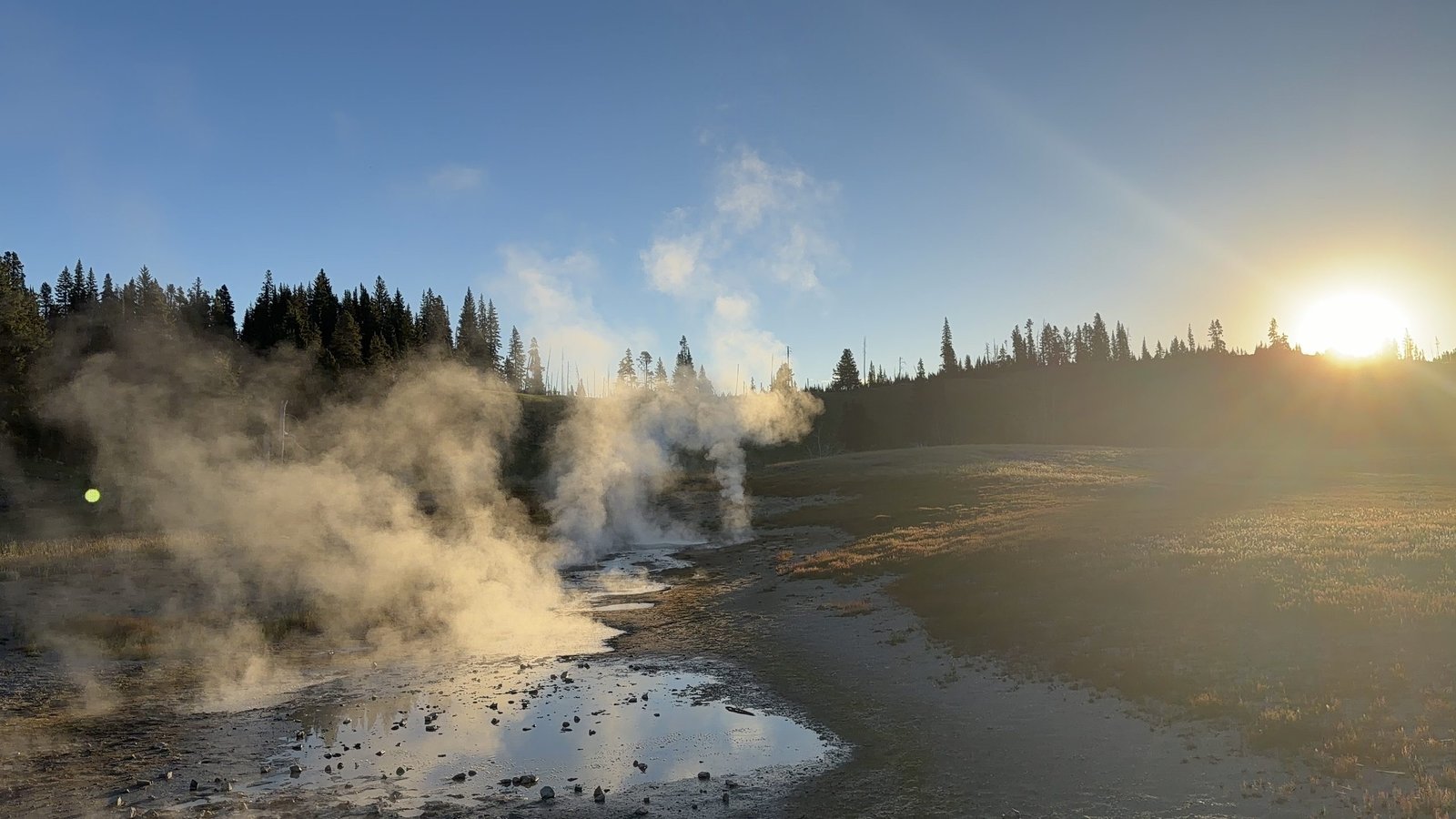
The drive in at dawn is the thing nobody tells you about.
Disclosure: Some links on our site are affiliate links. If you purchase a linked item, we will make a commission, at no extra charge to you.
You leave your campsite on the North Fork Highway before the sun is fully up, the Shoshone River still in shadow beside the road, and you drive west through the canyon with no one ahead of you and no one behind. You clear the East Entrance gate, climb through Sylvan Pass at 8,541 feet, and descend into a park that feels, at that hour, like it belongs entirely to you. The road stretches ahead through lodgepole pine and open meadow. The light comes in low and gold across the rock formations framing everything to the south. There is no traffic. There is almost no sound.
This is what the East Entrance offers that the other four gates into Yellowstone simply don’t: a corridor that rewards the traveler who arrives early, moves slowly, and understands that the approach to the park is part of the experience rather than the obstacle before it begins.
Why the East Entrance
Yellowstone has five entrances. Most visitors use the West, South, or North. The numbers tell the story plainly — in 2024, the West Entrance processed 777,409 vehicles. The East Entrance processed 166,942. Only about 7% of all Yellowstone visitors enter from this side.
That 7% is doing something right.
The West Entrance puts you in the Old Faithful corridor quickly, which is its appeal. The South Entrance connects from Grand Teton, which explains its traffic. The East Entrance puts you in the quietest, most wildlife-dense, most visually dramatic corner of the park — the corridor that runs from Sylvan Pass through Yellowstone Lake, into Hayden Valley, and northeast toward Lamar Valley. It does so through some of the most beautiful approach scenery in the American West, starting from a base camp in Cody that gives you the North Fork Highway every morning and every evening as part of the bargain.
The trade-off is distance. Old Faithful is about 80 miles from the East Entrance — two to two and a half hours of driving before you reach the geyser basin. For travelers staying near the West Entrance, that’s impractical. For travelers based in Cody, it’s simply Tuesday.
The Approach: Sylvan Pass and the High Country
The East Entrance Road begins climbing almost immediately after the gate, ascending through lodgepole forest to Sylvan Pass at 8,541 feet. Eleanor Lake appears first — a small alpine lake right off the road that most visitors drive past without stopping. Stop. Early morning light on that lake, with the pass rising behind it, is one of the quieter beautiful moments available on this corridor.
Sylvan Lake comes next, then the pass itself. In July, snow patches linger on the north-facing slopes above the road. The temperature drops noticeably at elevation.
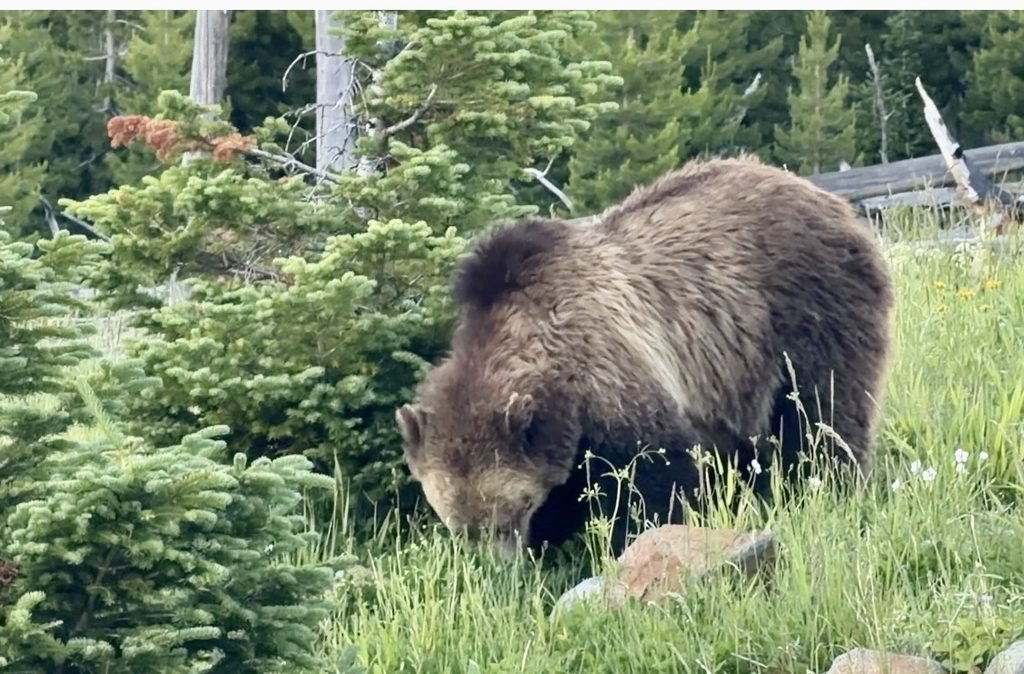
The descent from Sylvan Pass toward Yellowstone Lake is where the landscape opens. The first view of Yellowstone Lake — the largest high-elevation lake in North America at 7,733 feet — arrives without warning and takes a moment to process. Lake Butte Overlook Road, a mile-long spur off the main road, provides an elevated perspective on the lake — passenger vehicles only, no RVs or trailers. Steamboat Point follows, where fumaroles vent directly from the lakeshore. Mary Bay, Sedge Bay, Pelican Valley — the road traces the lake’s northern shore through some of the most wildlife-rich terrain on this side of the park. Pelican Valley is prime grizzly bear country. Scan the meadows every time.
What Sets This Corridor Apart
Here is what we kept coming back to: the wildlife and thermal features framed against the large rock formations on this side of the park are something the west side simply doesn’t offer in the same way. The volcanic geology that produced Yellowstone’s thermal features also produced the dramatic landscape you drive through to reach them — and on the east side, those two things are constantly in the same frame.
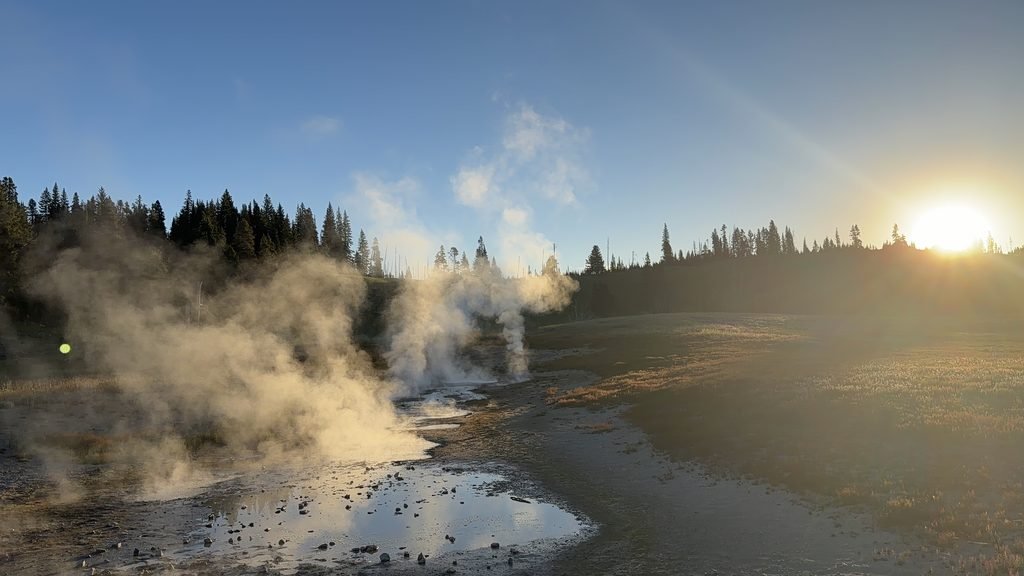
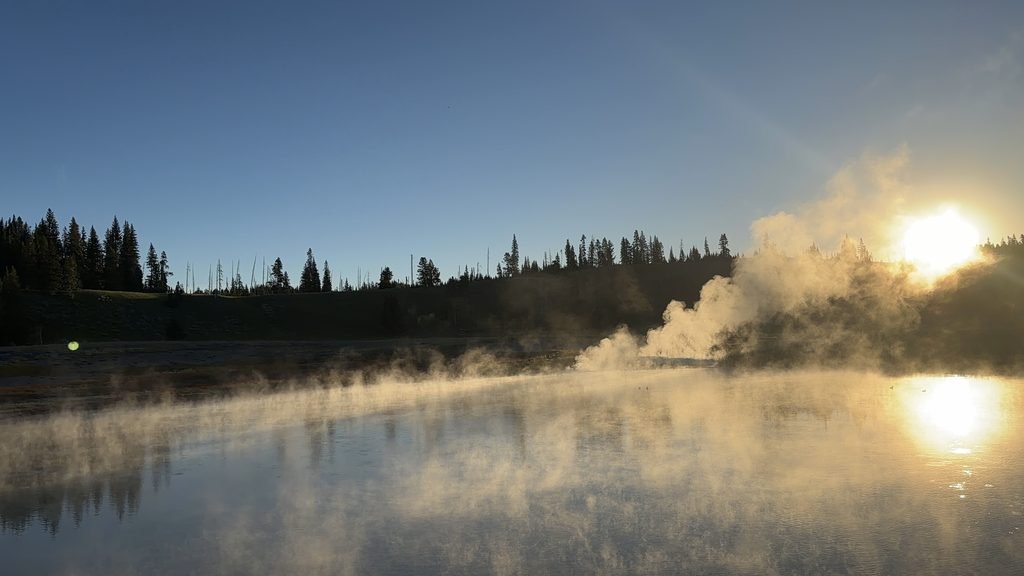
Steamboat Point puts geothermal steam against the backdrop of Yellowstone Lake and the Absaroka Range. The Mud Volcano area puts the most sulfurous thermal features in the park against open meadow. West Thumb Geyser Basin puts active geysers and hot springs directly on the shore of the lake. Nowhere else in Yellowstone does the thermal landscape and the broader natural landscape sit this close together this consistently.
The wildlife density on this corridor is the other defining characteristic. We saw wildlife before we were twenty minutes inside the gate on our first morning. We saw wildlife on every subsequent visit. The east side delivers on that particular promise reliably.
Hayden Valley
Forty miles inside the park from the East Entrance, the road drops into Hayden Valley and the landscape changes again. The Yellowstone River winds through the valley floor in broad meanders. Bison herds cross the road with the particular indifference of animals that have never needed to fear anything and know it. Grizzly bears are regularly spotted on the valley slopes. Wolves move through. Trumpeter swans float on the river.
Hayden Valley and Lamar Valley are the two best wildlife watching areas in the park. The morning drive through is almost always productive. The return drive in late afternoon is often better. Pull over whenever you see other vehicles stopped.
The Thermal Features
The East Entrance corridor gives you access to Yellowstone’s thermal features in a sequence that builds naturally from subtle to spectacular. The Mud Volcano area, mid-corridor, is where Dragon’s Mouth Spring exhales steam and sulfurous gas from a cave in the hillside with a sound that genuinely unsettles people the first time they hear it. Sulphur Cauldron sits directly across the road — one of the most acidic thermal features in the park.
West Thumb Geyser Basin, at the southwest corner of Yellowstone Lake, is the most visually distinctive thermal area on this entrance — active geysers and hot springs clustered on the lakeshore, the lake visible beyond them. The boardwalk loop takes thirty minutes and is rarely as crowded as the Old Faithful area.
Grand Prismatic Spring, in the Midway Geyser Basin further west, is the thermal feature most worth going out of your way for. Do not judge it from the boardwalk — take the Fairy Falls trail for the elevated view. From the overlook, the full concentric ring pattern — deep sapphire at the center, ringed by green, yellow, orange, and red — becomes clear simultaneously. It is one of the genuinely remarkable visual experiences in any national park.
Planning Your Days
The East Entrance corridor rewards a specific approach: arrive early, move slowly, and build your days around the morning wildlife window. The gate opens at dawn. Be there at dawn. By mid-morning the corridor picks up. By early afternoon the parking areas fill. The early advantage is real and consistent.
Weekdays are quieter than weekends on this side of the park. The drive from Cody to Old Faithful takes two to two and a half hours without stops. Plan full days for Old Faithful visits. Lamar Valley is best as its own dedicated day with a pre-dawn departure.
A Note on Dogs
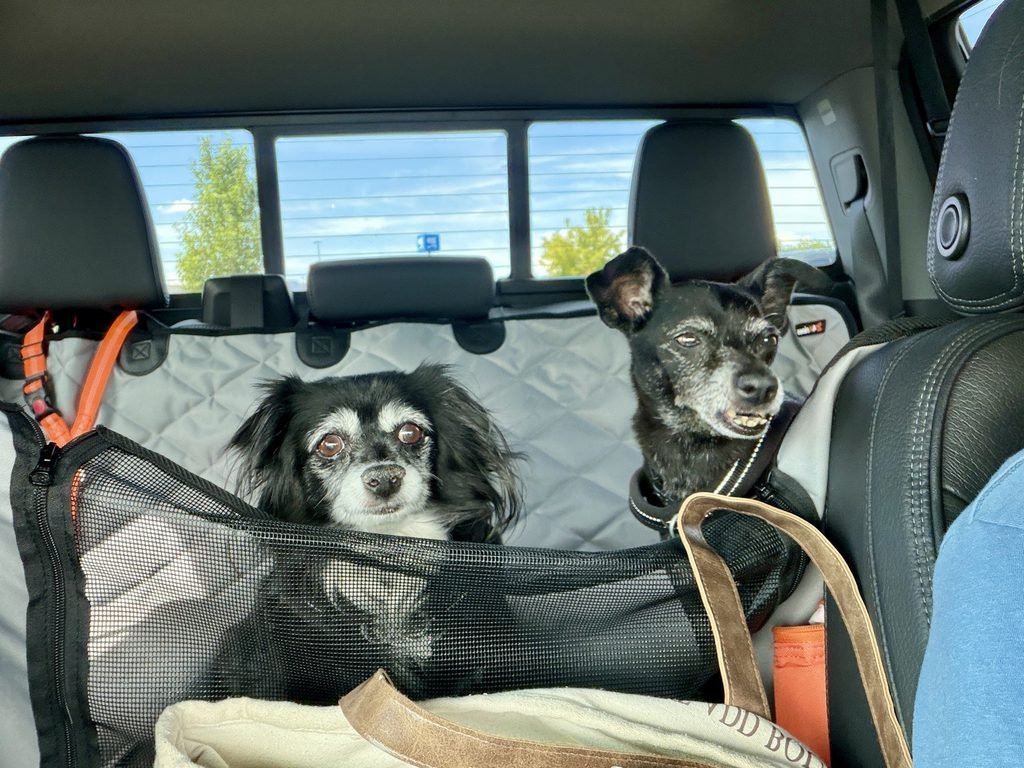
Yellowstone’s pet policy is more restrictive than most visitors expect. Dogs are permitted on paved surfaces, in parking lots, and within 100 feet of roads. They are not permitted on any boardwalk, trail, or backcountry area. Yellowstone does not permit dogs to be left unattended in vehicles — and in July temperatures inside a parked car can rise to dangerous levels within minutes. For the full picture of traveling Yellowstone with dogs, see our complete pet guide.
What the East Entrance Is
The 7% of Yellowstone visitors who come through this gate are not missing something the other 93% have found. They’ve found something the other 93% don’t know to look for.
The light on that road at dawn, before anyone else is out, with the canyon walls of the North Fork Highway still visible in the rearview mirror and the pass rising ahead — that’s what they’ve found. It’s worth finding.
The East Entrance to Yellowstone is 52 miles west of Cody via US-14/16/20. The annual America the Beautiful pass covers entry. For wildlife viewing, arrive at dawn. For Old Faithful and the Upper Geyser Basin, allow a full day. For travelers with dogs, our guide to Yellowstone’s pet policy covers everything you need to know.

Angela DiLoreto is a bestselling author, former Fortune 500 marketing executive, and a passionate advocate who successfully worked to change stalking laws in several states after a family friend was murdered by her stalker. That fight — for justice, for voices that weren’t being heard, for stories that needed to be told — runs through everything she does. She and her husband Vince travel the country by RV with their two rescue chihuahuas, Gracie and Loki, chasing history, great food, and the overlooked people and places that shaped America. Angela created Fitting in Adventure and the Historic Footnotes series because the best stories are usually the ones nobody’s heard yet.