
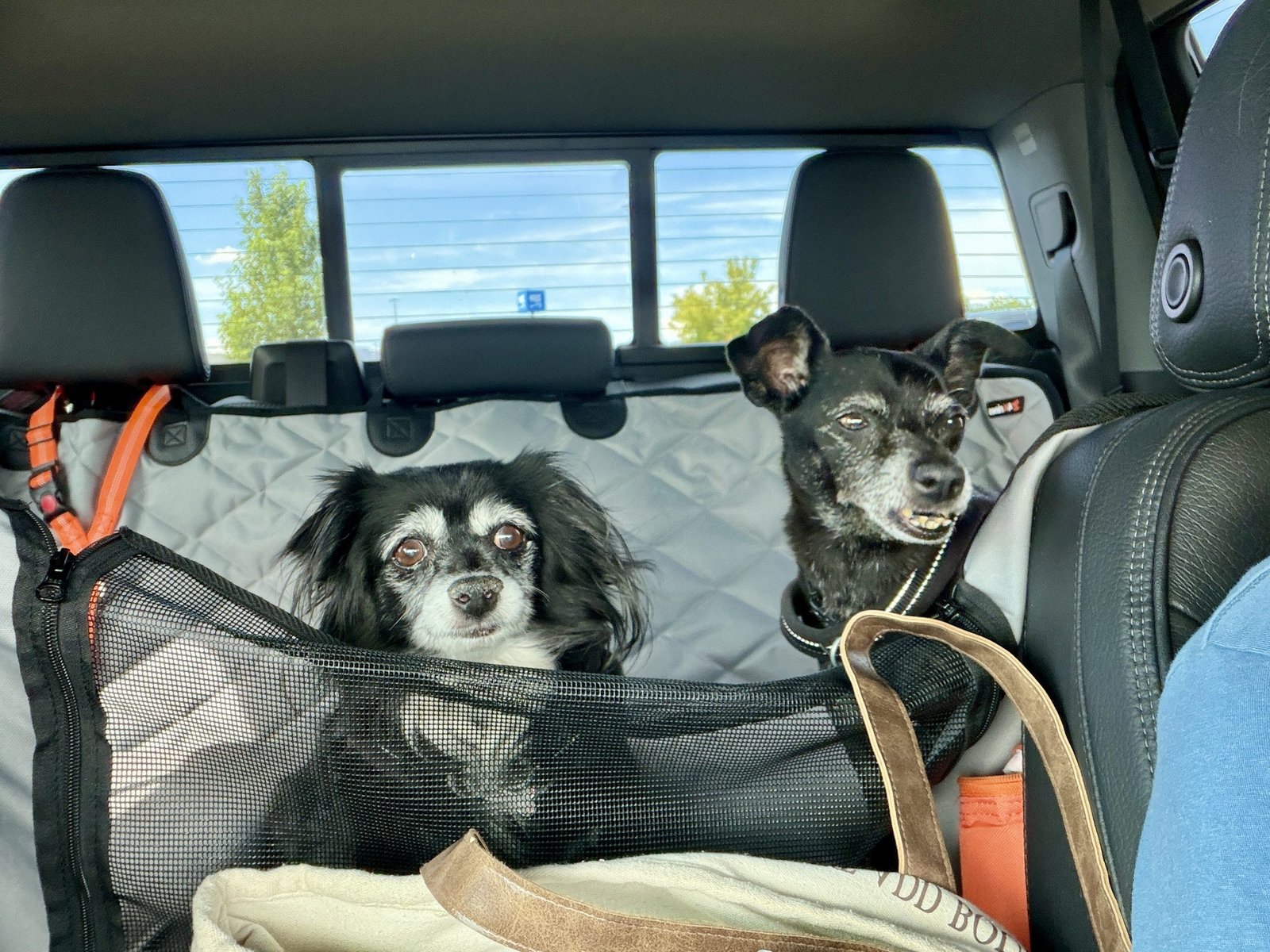
If you’re reading this article, you already know the frustration. You searched dogs in Yellowstone and got a paragraph on the NPS website and a dozen travel blogs that either copied it verbatim or got it partially wrong. You have dogs. You want to go to Yellowstone. You can’t find a clear, honest answer about what that actually looks like in practice.
Disclosure: Some links on our site are affiliate links. If you purchase a linked item, we will make a commission, at no extra charge to you.
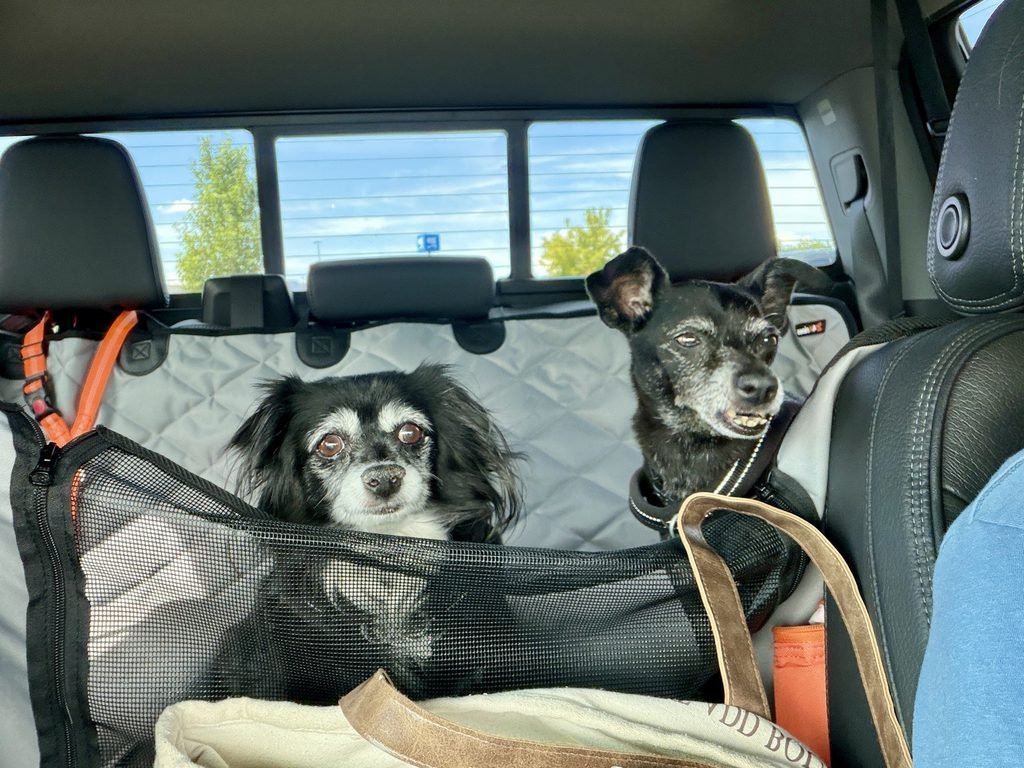
We went to Yellowstone with two dogs. Loki, our Chihuahua rescue, has a heart condition that requires daily medication and means we couldn’t leave him in the care of strangers at a daycare facility, couldn’t risk the stress of an unfamiliar environment, and couldn’t make decisions that prioritized our convenience over his stability. Gracie came along as his companion and because she goes where we go. Together they shaped every single day of our Yellowstone trip — not as an inconvenience, but as a genuine planning constraint that made us better travelers and, ultimately, gave us a different and richer experience of the region than we would have had otherwise.
This is what we learned.
The Rules — Clearly, Once and For All
Yellowstone’s pet policy is not complicated once you understand it, but it’s stated in ways that leave room for confusion. Here it is plainly:
Dogs are permitted in Yellowstone National Park in the following places: on paved surfaces, in parking lots, and within 100 feet of roads and parking areas.
Dogs are not permitted: on any trail, on any boardwalk, in any backcountry area, on any thermal feature boardwalk including Old Faithful, Grand Prismatic, West Thumb, Norris, and Mud Volcano, or in any park building.
Dogs must be on a leash no longer than six feet at all times.
Dogs may not be left unattended in vehicles. In July, temperatures inside a parked car can rise to dangerous levels within minutes even on a mild day. This is not a rule you want to test.
That last point is the one that catches most pet travelers off guard, and it’s the one that changed the shape of our entire trip. We use Marcell monitoring at our campsite to keep an eye on Loki and Gracie when we’re away from the RV. Inside Yellowstone, cell service is spotty at best — unreliable enough that we couldn’t count on the monitor working when we needed it. Which meant we took the dogs with us every single park day in the truck, and tag-teamed every boardwalk stop — one of us walking the boardwalk while the other stayed with the dogs, then switching.
What Tag-Teaming Actually Looks Like
Tag-teaming means one person on the boardwalk, one person with the dogs in the truck, then switch. It sounds simple and it mostly is, with some adjustments.
It adds time to every stop. Budget an extra thirty to forty-five minutes for any boardwalk visit if you’re tag-teaming, because you’ll see everything twice — once quickly to brief the other person on what’s worth seeing, once properly. The Old Faithful eruption is the exception: time it so both of you are watching when it goes, then split for the basin walk.
It requires genuine communication about what to see and in what order. We found that the second visit was often better — you move through with more intention when you know what’s ahead.
It means someone is always with the dogs, which for Loki meant someone was always monitoring his condition, his water intake, and his energy levels. In July heat, that matters for any dog. For a dog with a heart condition, it’s not optional.
If you’re traveling solo with dogs, tag-teaming isn’t available to you. The honest answer is that solo dog travelers face a genuine constraint on boardwalk access. You can do wildlife drives, lake stops, and paved pullouts fully and well. The boardwalk experiences require either leaving dogs at camp with appropriate setup, or accepting that some features aren’t accessible on this trip.
What You Can Do With Dogs — And It’s More Than You Think
Here is the part of this article that most pet travel guides miss: dogs can do a significant amount in Yellowstone, and the things they can do are genuinely excellent.
Lamar Valley wildlife drives are the best example. The wildlife watching in Lamar Valley is done entirely from your vehicle or roadside pullouts — the animals are best observed from a distance anyway, and staying in or near your vehicle actually improves the experience. We did both our Lamar Valley dawn drives with Loki and Gracie in the back seat, windows down, the three of us scanning the valley together at first light. Loki watched a bison cross the road twenty yards from the truck with his nose against the window glass and his ears up. That moment cost us nothing and gave us everything.
Hayden Valley works the same way. The bison herds cross the road. The river winds through the meadow. You pull over, cut the engine, and watch. Dogs in the vehicle are not only permitted but practically ideal.
Yellowstone Lake parking areas allow dogs. Some of the most beautiful lakeshore views in the park are visible from parking areas without any boardwalk required. Sedge Bay, Mary Bay, the pull-offs along the north shore — these are legitimate scenic stops that your dogs can share with you.
The East Entrance road itself — Sylvan Pass, the descent toward the lake, the mountain scenery between the gate and Fishing Bridge — is driven with your dogs. They experience it the same way you do, which is through the windows, and in July morning air that is cool and full of things worth smelling.
Cody as the Dog-Friendly Base Camp
The most important piece of advice we can give a dog owner planning a Yellowstone trip is this: base yourself in Cody.
Cody is the perfect dog-friendly base camp precisely because of Yellowstone’s restrictions — and that framing matters. The park’s limitations become less limiting when your home base has genuine dog-friendly infrastructure.
Beck Lake Dog Park is fenced, free, and has gated lake access where dogs can swim. There are separate areas for large and small dogs. Both dogs swam, Gracie repeatedly, Loki with his characteristic dignity and a clear opinion about the water temperature.
Paul Stock Nature Trail and the Shoshone Riverway Trail are flat, paved or packed gravel, river-adjacent, and welcoming to leashed dogs. They’re easy enough for dogs at any fitness level and beautiful enough that you won’t feel like you’re doing the consolation walk.
Shoshone National Forest begins essentially at the door of Yellowstone Valley Inn & RV Park and allows dogs on all trails on leash. America’s first national forest, established in 1891, is right outside your campsite. We used it for dog walks on every park day — real trail time, real terrain, real exercise for dogs who had been patient in the truck all morning.
Fat Racks BBQ has a dog-friendly patio. Small detail. Significant for a traveling dog owner who wants to eat somewhere that isn’t their campsite.
The Bark Ranger Program
Yellowstone offers a Bark Ranger program — a pledge and collectible tag available for purchase at visitor centers in the park. The tag certifies your dog as an official Bark Ranger and comes with a set of guidelines for responsible pet travel in national parks. Loki and Gracie have collected Bark Ranger tags at parks across their travels — more than seventy in total. Pick one up at any Yellowstone visitor center you stop at.
Managing Heat and Health
July in Yellowstone is warm. The park sits at high elevation — average around 7,875 feet — which moderates temperatures compared to lower elevations, but the summer sun is intense and parked vehicles heat fast.
For Loki specifically, heat management was part of every day’s planning. His heart condition means he cannot regulate his body temperature as efficiently as a healthy dog, which means shade, water, and airflow are non-negotiable requirements. On days when we left him at the RV, we ran a fan, ensured shade coverage, and confirmed the Marcell monitor was connecting before we drove into the park. On days when cell service dropped — which happened regularly inside Yellowstone — we took the dogs with us rather than leave them unmonitored.
If your dog has health considerations that limit your options, be honest with yourself about what that means before you go. Dog daycare near Cody is an option worth investigating if your dog’s health and temperament allow it. For us, with Loki’s medication schedule and the stress risk of an unfamiliar environment, it wasn’t an option. Tag-teaming was. We made it work.
What We’d Tell Another Dog Owner
If you can safely leave your dogs — with a trusted daycare, with a reliable monitoring setup — there are days in Yellowstone where that’s the right call. Old Faithful day is one of them. The Grand Canyon of the Yellowstone is another.
If you can’t, the way we couldn’t, the answer is not to skip Yellowstone. The answer is to plan differently, accept the constraints honestly, and discover that the things you can do with your dogs in this region are not the consolation version of the trip. They’re a different version, with different rhythms, and in some ways a slower and more attentive one.
Travel with your dogs. Know the rules. Plan around the constraints. And base yourself in Cody.
Yellowstone’s pet policy is maintained by the NPS and subject to change — verify current rules at nps.gov/yell before your visit. Beck Lake Dog Park is in Cody, Wyoming — free, open daily. For the full Cody dog-friendly picture, see our guide to dog-friendly Cody, Wyoming.

Angela DiLoreto is a bestselling author, former Fortune 500 marketing executive, and a passionate advocate who successfully worked to change stalking laws in several states after a family friend was murdered by her stalker. That fight — for justice, for voices that weren’t being heard, for stories that needed to be told — runs through everything she does. She and her husband Vince travel the country by RV with their two rescue chihuahuas, Gracie and Loki, chasing history, great food, and the overlooked people and places that shaped America. Angela created Fitting in Adventure and the Historic Footnotes series because the best stories are usually the ones nobody’s heard yet.