
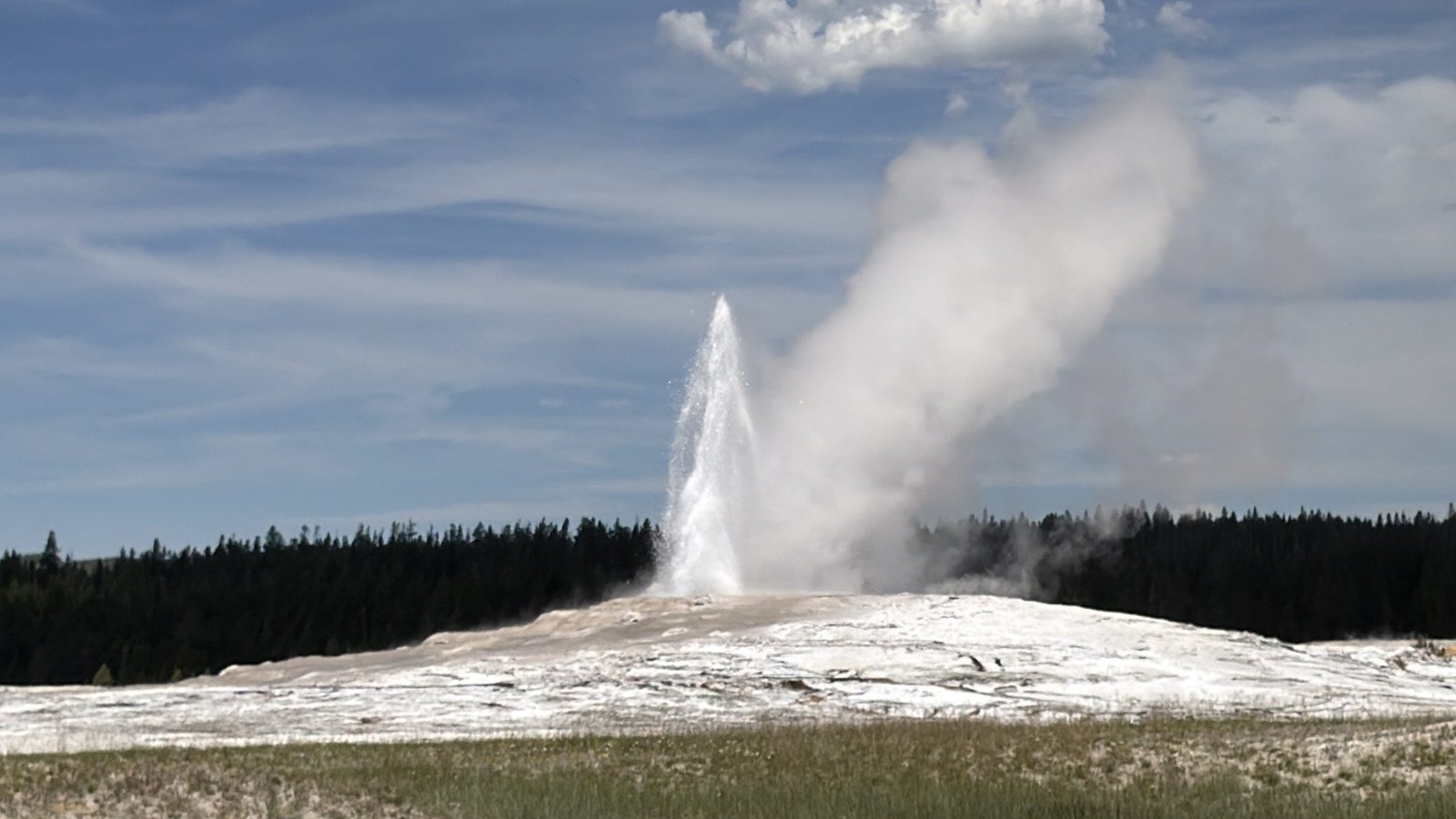
We’re going to be honest with you about Old Faithful, because the honest version is more useful than the version most travel writers give you.
Disclosure: Some links on our site are affiliate links. If you purchase a linked item, we will make a commission, at no extra charge to you.
You have to see it. It is one of the most recognizable natural features on earth, it has been erupting on a predictable schedule for as long as anyone has been watching, and standing in front of it when it goes is a genuinely impressive experience. You should go.
The crowds are intense. More crowded than we expected on a weekday in July, which is saying something given that we arrived with reasonable expectations for a world-famous geyser in peak summer season. None of that is a reason to skip it — it’s just information you should have before you go.
Here’s what most people don’t know: the moment you walk away from Old Faithful and into the Upper Geyser Basin, the crowds thin dramatically. The basin contains the largest concentration of geysers on earth, and most of the people who came to see it are standing in one spot waiting for one geyser. Walk ten minutes in any direction and you’ll find features just as remarkable with a fraction of the audience.
That’s the Old Faithful secret. It’s not really about Old Faithful.
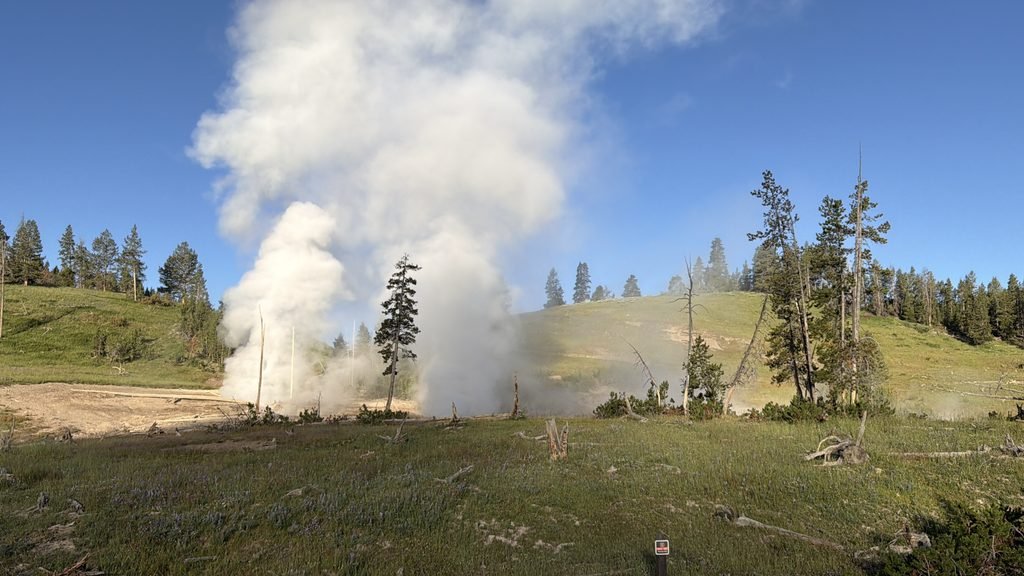
Getting There From the East
From your base camp on the North Fork Highway, Old Faithful is approximately 80 miles and two to two and a half hours of driving. Leave by 6:30AM. The drive itself is worth the early departure — the East Entrance road at dawn, Sylvan Pass descending toward Yellowstone Lake, the Hayden Valley wildlife corridor — and arriving before the midday crowd makes the Old Faithful experience meaningfully better.
Check the eruption prediction board at the Old Faithful Visitor Center before you do anything else. Average interval is around 90 minutes. If you arrive to find the next eruption is 75 minutes away, walk the basin first and return. Let the board make the decision for you.
Old Faithful
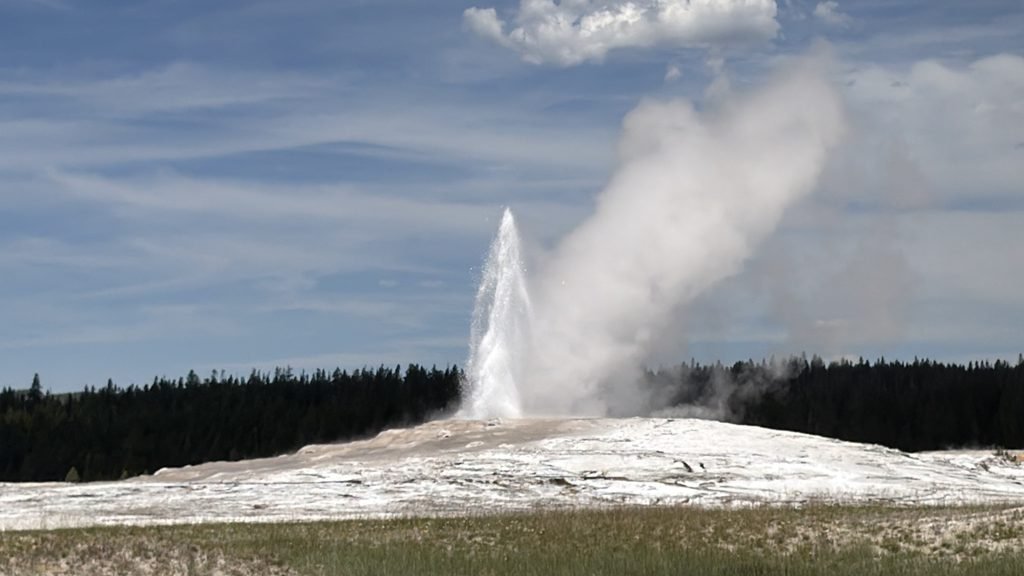
Old Faithful has been erupting reliably since at least 1870. It erupts to heights between 100 and 180 feet, lasts between one and a half and five minutes, and discharges somewhere between 3,700 and 8,400 gallons of boiling water per eruption. The predictability that made it famous comes from the particular geometry of its plumbing system.
The eruption itself is worth watching. There’s a building phase — a series of false starts, small bursts of steam, the water rising and falling before the full column finally commits. When it commits, it commits. The column rises fast and the sound reaches you a beat after the visual, and for the duration of the eruption the crowd goes quiet in the particular way that large groups of people go quiet when something is actually happening.
Our suggestion: don’t be one of the people moving toward the parking lot after the eruption. Be one of the people moving away from Old Faithful and deeper into the basin.
The Upper Geyser Basin
The Upper Geyser Basin stretches roughly two miles along the Firehole River from Old Faithful to Morning Glory Pool, containing more geysers per square mile than anywhere else on earth. The sheer number of active features in this basin is what surprises people who arrived thinking Old Faithful was the point. It isn’t. Old Faithful is the introduction.
Castle Geyser sits about a quarter mile from Old Faithful and is immediately distinctive — a massive cone built up over thousands of years of mineral deposits. It erupts every ten to twelve hours to heights of 75 feet.
Grand Geyser is the tallest predictable geyser in the world, erupting every seven to fifteen hours to heights of 150 to 200 feet. It erupts in a series of bursts rather than a single column, which makes it visually more dramatic than Old Faithful despite being less famous. Check the prediction board for Grand — most visitors leave without knowing it exists.
Riverside Geyser erupts over the Firehole River, arching water across the stream at a low angle that’s more graceful than dramatic and more beautiful for it. The setting — a geyser erupting directly into a river, surrounded by forest — is unlike anything else in the basin.
Morning Glory Pool sits at the far end of the main loop and is worth every step of the walk. The color is the thing — a deep cobalt blue at the center that shifts through turquoise to green to yellow at the edges.
Grand Prismatic Spring
Grand Prismatic Spring is in the Midway Geyser Basin, about two miles north on the same road. It deserves its own paragraph because it requires a specific instruction that most visitors don’t receive until after they’ve already made the wrong choice.
Do not judge Grand Prismatic from the boardwalk.
The boardwalk view at ground level shows you a large blue pool with colored edges and a lot of steam. It’s underwhelming. Take the Fairy Falls trailhead, located in the Midway Geyser Basin parking area. Walk 0.6 miles to the Grand Prismatic overlook. The view from the overlook shows you the full concentric ring pattern — deep sapphire blue at the center, ringed by green, then yellow, then orange, then red. From above, you understand what you’re looking at. From the boardwalk, you don’t.
We cannot overstate the difference between the two experiences. The overlook is one of the genuinely remarkable visual moments available in any national park in the country. The boardwalk is a large hot spring.
West Thumb Geyser Basin
West Thumb sits on the shore of Yellowstone Lake, roughly 17 miles east of Old Faithful — a natural stop on the drive between the lake corridor and the geyser basin. The crowds are a fraction of what you’ll find at Old Faithful, and what West Thumb offers in exchange is unique in the park: active geysers and hot springs clustered directly on the shore of the largest high-elevation lake in North America.
Fishing Cone, a small geyser sitting in the lake itself, is the detail that stays with you. Historical accounts describe fishermen catching trout in the lake and swinging them directly into the boiling cone to cook — a story that is both true and inadvisable to attempt today.
On our drive through the West Thumb area we came across something we hadn’t planned for and didn’t expect — a family of moose moving through the timber near the lake shore. Moose are the most elusive of Yellowstone’s large mammals, less reliably spotted than bison, elk, or even bears, and seeing a family group is the kind of encounter that reframes an entire day. Slow down through the West Thumb corridor and scan the forest edges and marshy areas near the water. They’re there. Most people drive past without looking.
Give West Thumb thirty to forty-five minutes. It earns them.
Managing the Day
An Old Faithful day from the East Entrance is a full day. Leave early. Check the eruption board first. Walk away from Old Faithful after the eruption rather than toward the parking lot. Take the Fairy Falls trail for Grand Prismatic. Stop at West Thumb on the way back.
The crowds at Old Faithful are real and they’re not going anywhere. The rest of the basin, the moment you leave the immediate Old Faithful area, is a different experience — one that most of the people in that parking lot will never have because they came for one geyser and left when they’d seen it. Don’t be most people.
Old Faithful is in the Upper Geyser Basin in the southwest corner of Yellowstone. From the East Entrance, allow two to two and a half hours each way. Check the eruption prediction board outside the visitor center. The Fairy Falls trailhead for Grand Prismatic is in the Midway Geyser Basin parking area, approximately two miles north of Old Faithful. Dogs are not permitted on any boardwalk.

Angela DiLoreto is a bestselling author, former Fortune 500 marketing executive, and a passionate advocate who successfully worked to change stalking laws in several states after a family friend was murdered by her stalker. That fight — for justice, for voices that weren’t being heard, for stories that needed to be told — runs through everything she does. She and her husband Vince travel the country by RV with their two rescue chihuahuas, Gracie and Loki, chasing history, great food, and the overlooked people and places that shaped America. Angela created Fitting in Adventure and the Historic Footnotes series because the best stories are usually the ones nobody’s heard yet.