
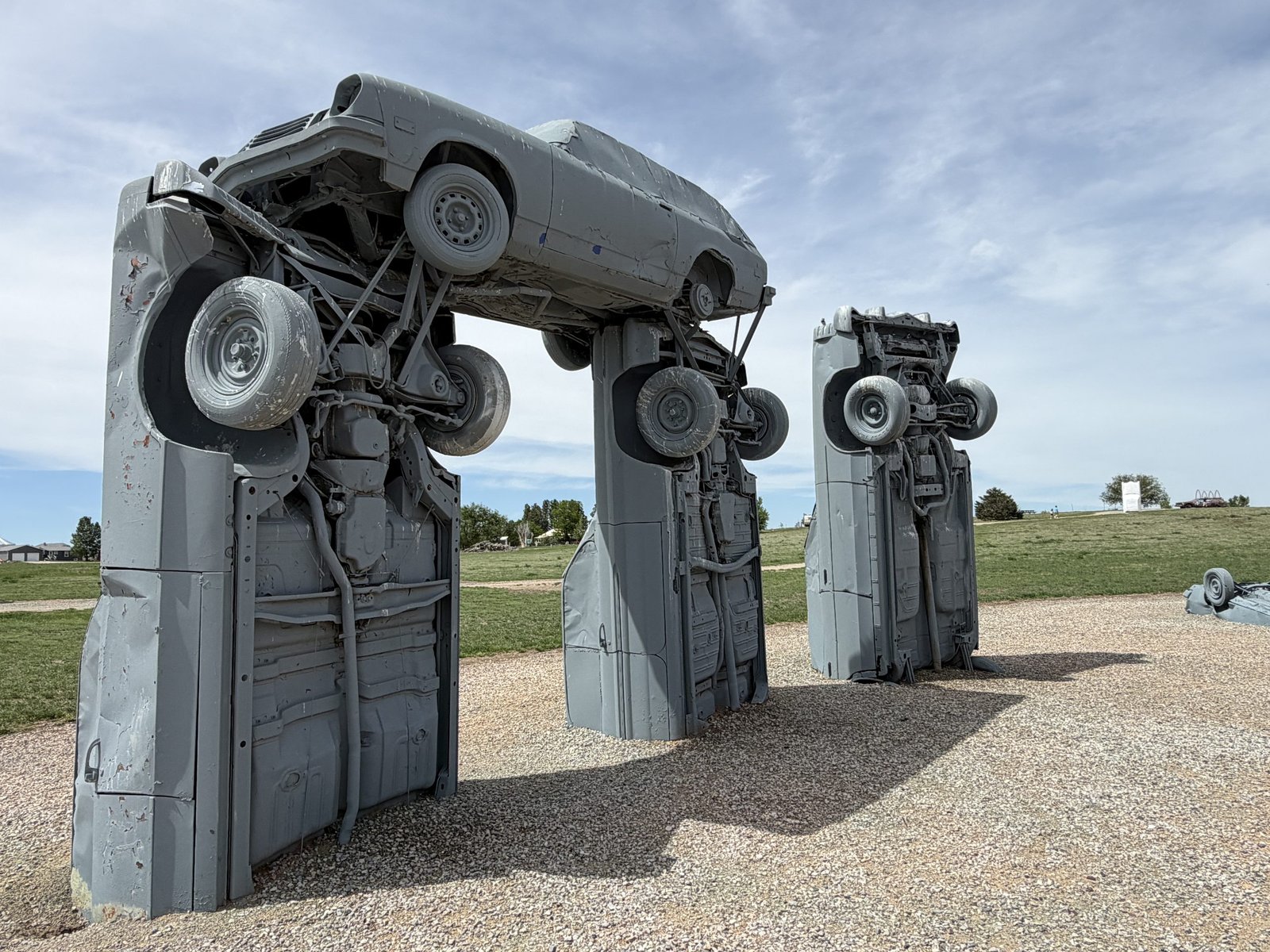
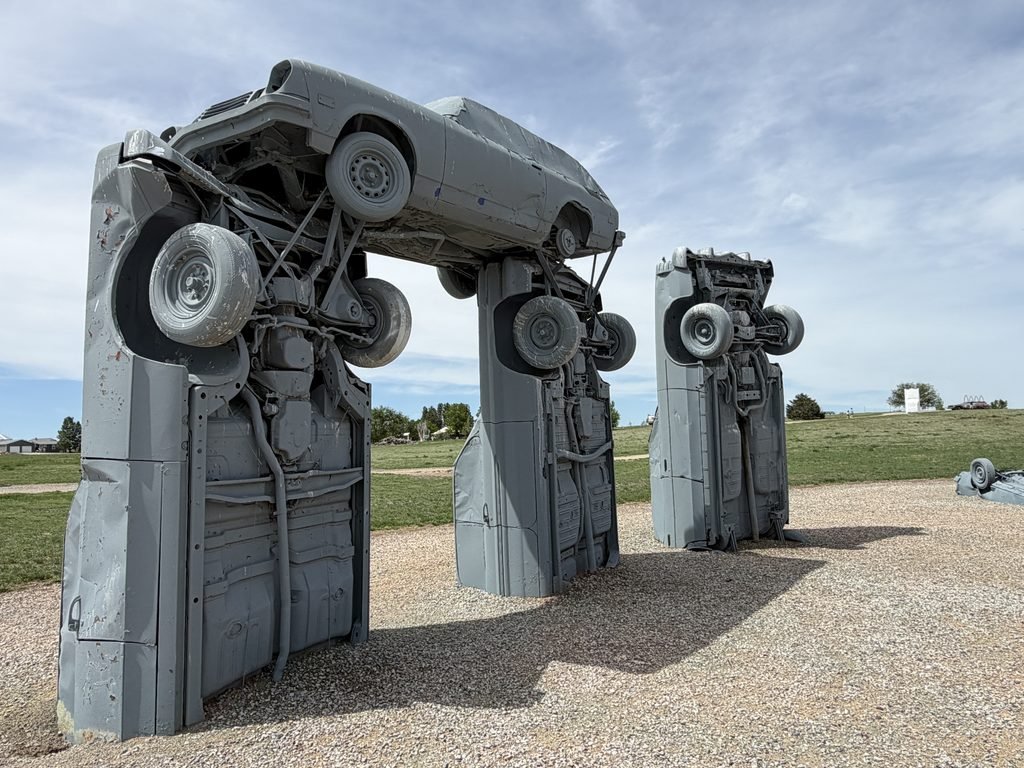
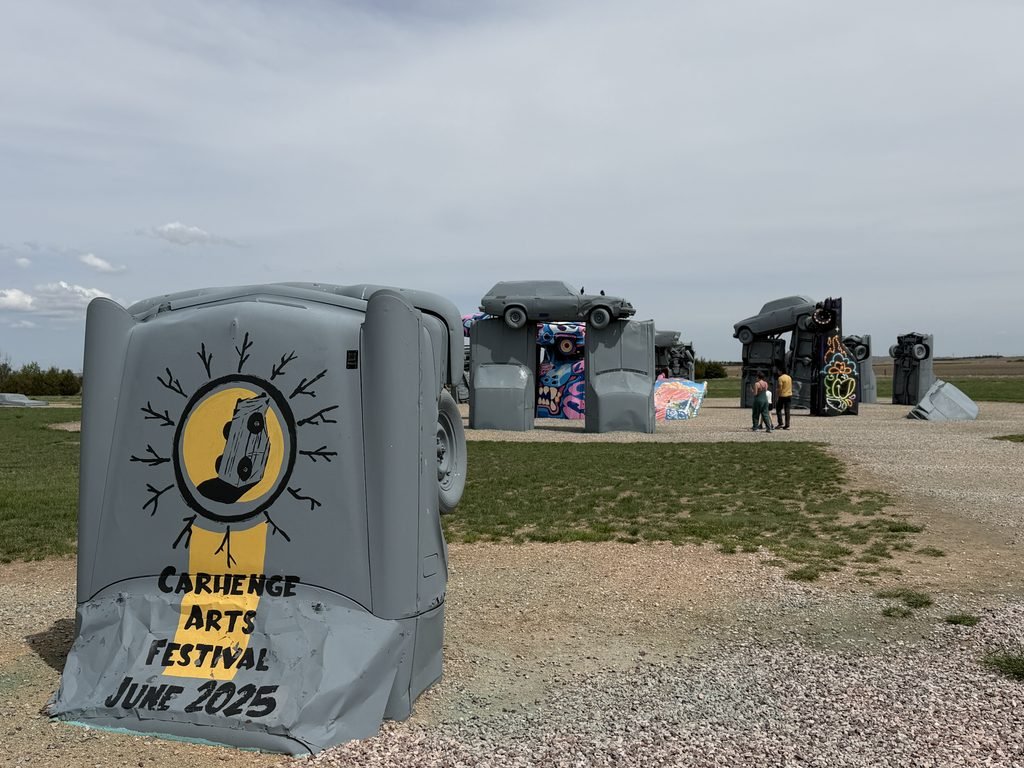
North of Alliance, Nebraska, the wheat fields give way to something that has no business being there. It’s midday when we pull off, the sky doing that huge, uninterrupted Panhandle thing it does, wind pushing hard enough across the open field that it’s the first thing you notice — before the cars, before the shape of the thing even registers as Stonehenge. Thirty-eight of them stand nose-down in the dirt, arranged in a ring, gray as ash, holding the exact proportions of a five-thousand-year-old monument four thousand miles away. The wind moves through empty window frames instead of standing stone. It is Stonehenge translated into the language of the American road — Detroit steel instead of Wiltshire sarsen — and it is exactly as strange, and exactly as moving, as that sounds.
Disclosure: Some links on our site are affiliate links. If you purchase a linked item, we will make a commission, at no extra charge to you.
The Memorial Behind the Monoliths
Carhenge exists because of one man’s grief and one man’s stubbornness. Jim Reinders, an engineer who spent years working in England, spent that time studying the design and layout of the real Stonehenge — the way the stones were spaced, angled, and scaled.
The idea sat until 1982, when Reinders’ father died and the family gathered on the old Reinders farm north of Alliance for the funeral. Five years later, in June 1987, roughly three dozen family members returned to that same field and spent about a week hauling in junked cars — a 1950 DeSoto, a 1975 AMC Gremlin, and dozens in between — to build Reinders a memorial to his dad. They planted the cars trunk-down, welded the horizontal “lintels” in place, and dedicated the whole thing at the summer solstice, the same alignment the original builders in England cared about five thousand years earlier.
The circle runs 96 feet across, matched deliberately to Stonehenge’s real proportions, with certain cars rising 15 to 17 feet in the air to stand in for the largest sarsens. A handful of the tallest vehicles were later fitted with plate metal in place of glass and repainted flat gray — the same protective coat that gets reapplied every three to five years, since a field this exposed to Panhandle wind sandblasts paint off steel about as fast as it can be put on.
Alliance did not exactly welcome it. Neighbors wanted it torn down, and for a while the state highway department wanted to fence it off as a junkyard. That reception has long since flipped — Carhenge is now the thing Alliance is known for, gifted by the Reinders family first to a nonprofit called Friends of Carhenge and then, in 2013, to the city itself.
More Than the Ring
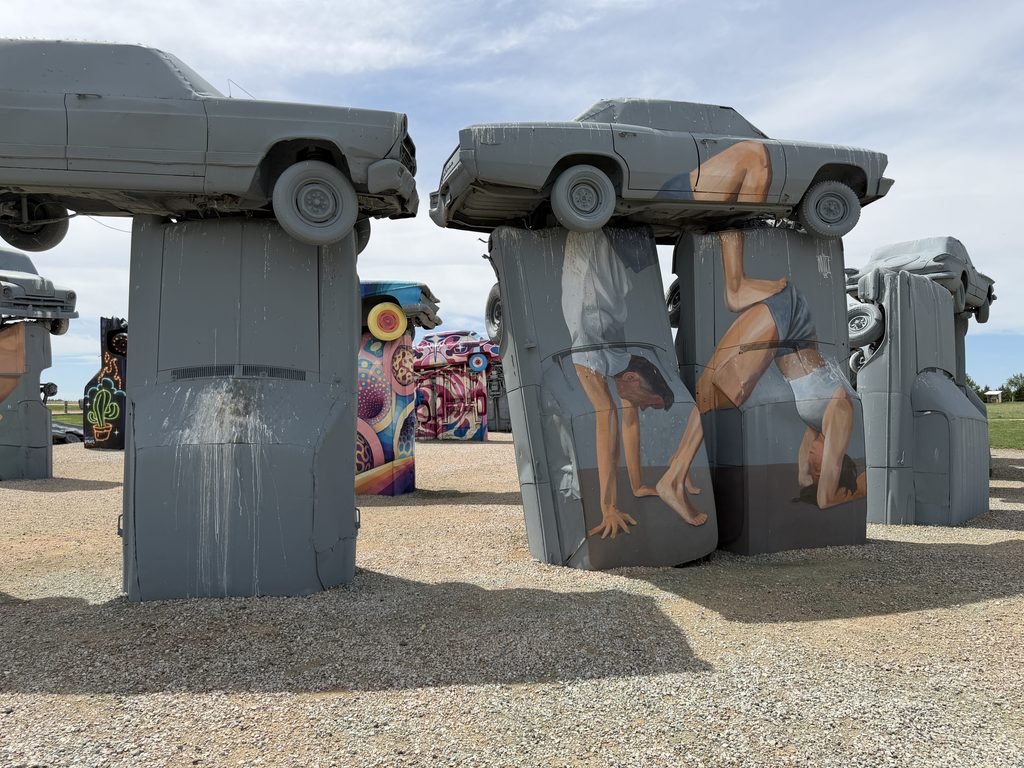
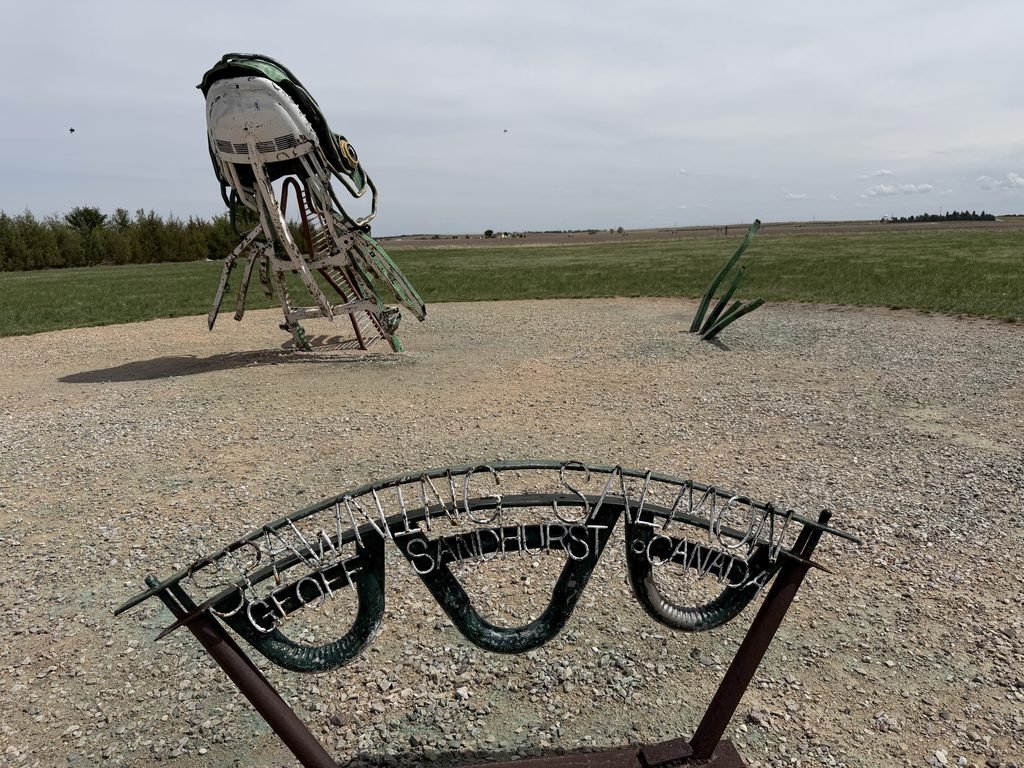
The site has grown well past its original 38 cars into what’s now called the Car Art Reserve. Reinders kept building after Carhenge caught on: “Fourd Seasons” uses only Ford bodies, painted to move through the colors of a Nebraska farming year from green spring shoots to the white of a snowbound winter field. “Three Bells” stands in for Reinders and his two siblings. Local and touring artists have since added a metal dinosaur skeleton, a spawning salmon, and a wind chime sculpture built from car frames large enough to hear from the parking lot.
One detail visitors tend to remember: for a stretch, Reinders pulled a Toyota out of the lineup, saying he wanted an American Carhenge rather than a Japanese one — a small, telling piece of the site’s DNA. Every few years, a rotating cast of painters, some locally known and some with wider reputations, repaint select cars as part of an annual art event, so the ring doesn’t look quite the same on every visit.
Planning the Stop
- Address: 2151 Country Road 59, just north of Alliance, NE, off Highway 87
- Hours: open daily, roughly 8 a.m. to 7 p.m., year-round — it’s an open field, so there’s no gate to time around
- Cost: free, donations welcome
- The Pit Stop gift shop and visitor center run seasonally (summer); in the off-season, Carhenge merchandise is sold at the Knight Museum & Sandhills Center in downtown Alliance
- Plan on 20–45 minutes — longer if you’re photographing every sculpture in the Car Art Reserve, not just the ring
- It’s an open, wind-exposed field with no shade — the same wind that sandblasts the paint off the cars will find you too, so dress for it
- Dogs are welcome on-leash, but ours sat this one out at the RV — there’s no shade and signs indicate rattlesnakes are prevalent
Why It’s Worth the Detour
Carhenge isn’t subtle, and it isn’t trying to be. It’s a monument to a father, built out of whatever the family had on hand, in a part of the country where the horizon runs flat for miles and a ring of gray cars is visible from the highway before you’ve even decided to pull off. That’s the whole appeal — it takes the reverence people bring to the real Stonehenge and points it at a Nebraska wheat field instead, without apologizing for the joke.

Angela DiLoreto is a bestselling author, former Fortune 500 marketing executive, and a passionate advocate who successfully worked to change stalking laws in several states after a family friend was murdered by her stalker. That fight — for justice, for voices that weren’t being heard, for stories that needed to be told — runs through everything she does. She and her husband Vince travel the country by RV with their two rescue chihuahuas, Gracie and Loki, chasing history, great food, and the overlooked people and places that shaped America. Angela created Fitting in Adventure and the Historic Footnotes series because the best stories are usually the ones nobody’s heard yet.