
Cody rewards the traveler who slows down. The obvious stops — the Buffalo Bill Center, the rodeo, the drive to Yellowstone — are obvious for good reasons. But there’s a second layer to this town that most people miss entirely, not because it’s hard to find but because nobody told them to look.
Disclosure: Some links on our site are affiliate links. If you purchase a linked item, we will make a commission, at no extra charge to you.
These are the four stops we almost skipped. We’re glad we didn’t.
Old Trail Town
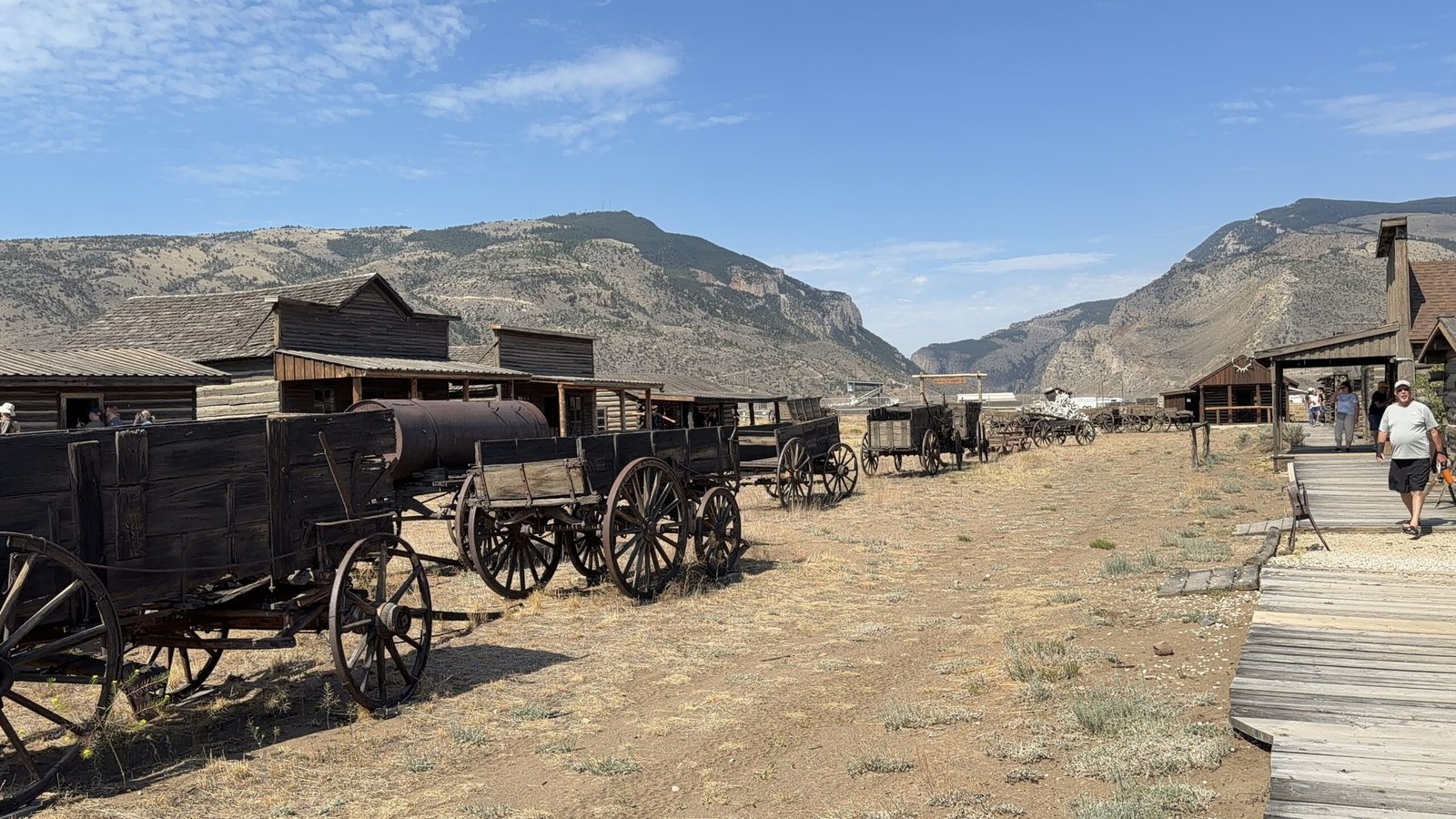
A mile west of downtown, past the rodeo grounds and off the main tourist corridor, Old Trail Town doesn’t announce itself. There’s no dramatic entrance, no billboard campaign, no queue of visitors waiting outside. What there is, once you walk through the gate, is something genuinely difficult to find anywhere in the American West: authenticity at scale.
More than twenty-five historic Western structures — saloons, cabins, a trapper’s camp, a smithy, a church — relocated from across the region and reassembled on a single site alongside the Museum of the Old West. The sheer number of structures in one place stopped us. You keep turning a corner expecting to reach the end of it and finding another building, another story, another piece of the region’s history that someone decided was worth saving.
Nothing prepared us for how authentic it felt.
That word gets used carelessly in travel writing, so let’s be specific about what we mean. The buildings are not reconstructions. They are not replicas. They were located, documented, carefully dismantled, transported, and reassembled here by a man named Bob Edgar who spent decades doing exactly that work because he believed these structures deserved to survive. The cabin that served as a hideout for Butch Cassidy and the Sundance Kid is real. Curley’s Cabin — Curley being the Crow scout who rode with Custer and survived the Little Bighorn — is real. The Rivers Saloon was a real saloon where real people drank and argued and made decisions they probably reconsidered later.
The result is a place that feels genuinely inhabited by its own past. Not performed. Not packaged. Just preserved.
Walk slowly. Read every sign. Give it two hours and you’ll wish you’d given it three. Old Trail Town is the stop that most consistently surprises people who thought they already understood Cody, and it costs less than almost anything else you’ll do here.
The Irma Hotel
Buffalo Bill named the Irma Hotel after his youngest daughter. He opened it in 1902, marketing it as the most modern hotel in the Rockies — a staging point for Yellowstone travelers, a place where the journey west felt like it was already worth making before the park ever came into view.
What we didn’t expect, walking in more than a century later, was that it would still feel like a place rather than a monument.
The Irma is still operating. Still a hotel, still a bar, still alive in the way that buildings with real histories sometimes manage to stay alive when lesser places have long since been converted into something more profitable. That continuity is the thing that strikes you first — the sense that this building has been in continuous use since the year it opened, accumulating the particular density that only time produces.
The cherrywood bar is the detail everyone mentions, and it deserves the mention: it was a gift from Queen Victoria, sent to Buffalo Bill following his command performances before the British royal family. It arrived in Cody and it has been here ever since. Standing next to it is the kind of experience that travel occasionally produces and rarely promises — a genuine connection across an enormous distance of time, mediated by a piece of furniture that has outlasted nearly everyone who ever leaned against it.
Go for a drink. Sit at the bar if there’s room. The point is the building, the bar, and the particular feeling of being inside something that has been continuously itself for over a hundred and twenty years. The Irma is at 1192 Sheridan Avenue. Most visitors walk past it without going in. Don’t be most visitors.
Buffalo Bill Dam
Five miles west of Cody on the North Fork Highway, the canyon narrows and Buffalo Bill Dam appears across the gap — a concrete arch spanning rock walls so tight it seems like a problem that shouldn’t have a solution.
When construction was completed in 1910, it was the tallest dam in the world at 325 feet. The engineering required to build it in that location, in that era, with the technology available, is the kind of story that tends to get lost because the result looks inevitable in retrospect. It wasn’t. Workers drilled and blasted in a canyon so narrow that sunlight barely reached the construction site. The project took five years and required solutions to problems that had no precedent.
The visitor center is free and tells that story well. Walk across the dam itself — the view down into the canyon takes a moment to process, and the reservoir stretching away to the west is a different and quieter kind of dramatic. Dogs are welcome in the parking area and outside.
We stopped here every time we drove the North Fork Highway. The light is different every hour.
The North Fork Highway
Most people drive the North Fork Highway as a means to an end. They’re going to Yellowstone, or they’re coming back from it, and the road between is the part they’re trying to get through. That’s a significant mistake, and it’s one that’s easy to make because nobody tells you otherwise.
The North Fork Highway — US-14/16/20, also called the Buffalo Bill Scenic Byway — runs 52 miles from Cody to Yellowstone’s East Entrance through the Wapiti Valley and the Shoshone Canyon. Buffalo Bill marked out the original wagon road along this corridor because he understood that the journey to Yellowstone was part of the product he was selling. He was right.
The Shoshone River runs right alongside the road the entire way. Not occasionally alongside it, not visible in the distance — right there, moving fast and green through the canyon, close enough on some stretches that you could step from the shoulder directly to the bank. The Absaroka Range frames everything to the south and west. The canyon walls change color and character mile by mile.
Roughly twelve miles west of your base camp, watch for the Holy City — a cluster of volcanic hoodoo formations on the south side of the road that most drivers pass at speed without registering what they are. Pull over. The rock faces catch the morning light in a way that’s worth five minutes of your time even when you’re trying to get somewhere.
The North Fork Highway is best driven slowly, twice a day, in different light. We drove it every morning heading west toward the park and every evening coming back east toward camp, and it was different every time. That river never looked exactly the same twice.
Old Trail Town: 1831 Demaris Dr, Cody — open May through September, check hours before you go. The Irma Hotel: 1192 Sheridan Ave. Buffalo Bill Dam: free, 5 miles west of Cody on US-14/16/20, open daily. The North Fork Highway runs the full 52 miles between Cody and Yellowstone’s East Entrance.
Vince DiLoreto spent 20 years in the United States Air Force seeing the world before deciding to see it properly — this time with a camera, an RV, and considerably better food. A trained photographer and the visual half of Fitting in Adventure, Vince captures the places, people, and moments that make every trip worth telling. When he’s not behind the lens, he’s behind the wheel, which means he’s seen every gas station between Florida and the Pacific Northwest.