
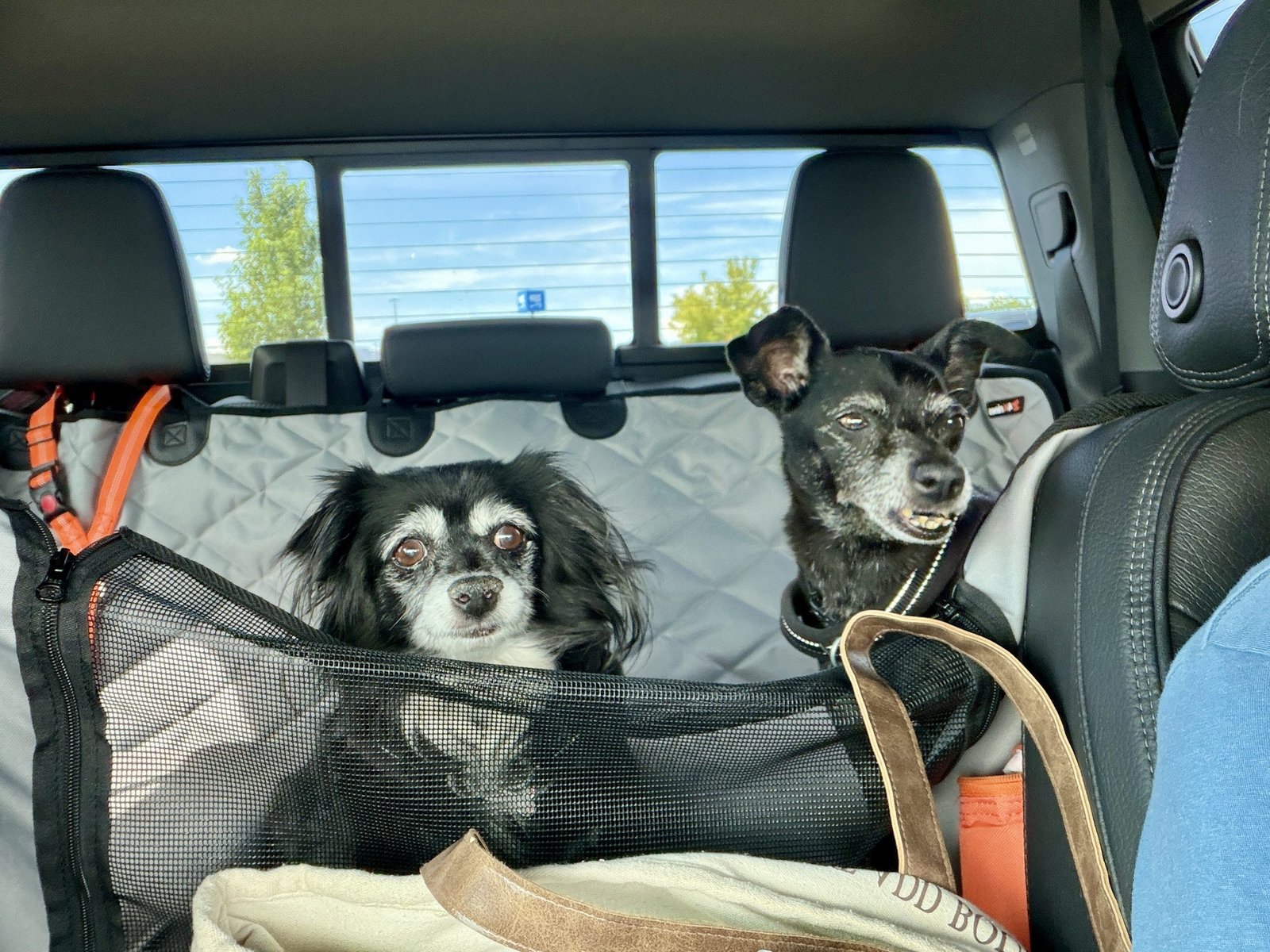
Loki and Gracie have collected more than fourty Bark Ranger tags across their travels. That number represents a lot of national parks, a lot of miles, a lot of decisions made around two small dogs who didn’t ask to live in an RV but have adapted to it with a grace that continues to surprise us.
Disclosure: Some links on our site are affiliate links. If you purchase a linked item, we will make a commission, at no extra charge to you.
They have limited some experiences. They have enriched others we wouldn’t have found otherwise. That’s the honest summary of what it means to travel full-time in an RV with dogs, and it’s the summary we wish someone had given us before we started.
This is what we’ve learned.
Know Your Dog’s Limits Before You Go
Loki has a heart condition. He takes daily medication. He cannot be left in environments that cause him stress, cannot overheat without serious consequence, and cannot be handed off to a stranger at a daycare facility when the itinerary gets inconvenient. Those constraints are not negotiable, and they shaped every single day of our Cody and Yellowstone trip — not as limitations we resented but as parameters we planned around from the beginning.
Knowing your dog’s limits before you leave home is the foundation of everything else. Not in the abstract — but specifically: what temperature is too hot, how long can he be in the truck before he needs to move, what does stress look like in his body and how quickly does it escalate, what happens if his medication schedule slips by two hours on a long driving day.
Gracie’s limits are different. Smaller dog, different temperament, different physical needs. Traveling with two dogs means traveling with two sets of parameters that sometimes align and sometimes require separate management.
If your dog has health considerations, talk to your vet before a trip of this length and complexity. Get specific. Ask what heat threshold requires intervention, what signs indicate the dog is struggling, what adjustments to medication timing are safe on travel days. We did this before the Cody trip and the information changed specific decisions we made on specific days.
Routine Is the Foundation
Dogs experience travel differently than humans do. What we experience as variety and stimulation — new places, new smells, new schedules — dogs experience as unpredictability, and unpredictability is stressful for most dogs regardless of temperament.
The antidote is routine. Feeding at the same times every day regardless of what the day holds. Walks at predictable intervals even when the schedule is complicated. Bedtime in the same space — the RV is home precisely because it’s the consistent physical environment that moves with the dogs rather than asking the dogs to adapt to a new one every night.
On the Cody trip, we maintained Loki’s medication schedule around everything else rather than the other way around. Morning medication before we drove anywhere. Evening medication at the same time regardless of when we returned from the park. That consistency is not glamorous and it doesn’t make for interesting content, but it’s the difference between a dog who travels well and a dog who is quietly suffering through a trip that looks fine from the outside.
The mornings we left earliest for Yellowstone — before 5:30AM on Lamar Valley days — were the mornings that required the most deliberate routine management. Feeding adjusted slightly, walk shortened but not skipped, both dogs settled in the truck before we pulled onto the North Fork Highway. Disrupting the routine entirely creates a stressed dog before the day has started. Adjusting it carefully produces a dog who is ready to travel.
Heat Management Is Non-Negotiable
Small dogs and heat are a serious combination, and RV travel in July in Wyoming requires taking that seriously every day.
In the RV at camp, we run a fan when the temperature climbs and ensure shade coverage on the side the sun hits. The Marcell monitoring system gives us eyes on the dogs remotely — temperature alerts, camera access, the ability to confirm they’re settled before we’re out of cell range. On the North Fork Highway and inside Yellowstone, cell service drops off quickly, which is why we brought the dogs with us on every park day rather than leaving them at the RV unmonitored.
In the truck, the same principles apply. We do not leave dogs in a parked vehicle in July in Wyoming. The temperature inside a parked car rises faster than most people realize — within minutes on a warm day. Every stop that requires leaving the truck requires a plan for the dogs before we leave the campsite in the morning, not in the parking lot when we arrive.
On driving days, we stop every two hours regardless of whether the dogs signal that they need it. Small dogs have small bladders, but more importantly they have limited ability to communicate discomfort before it becomes distress. Regular stops are not an inconvenience. They’re the job.
Gear That Actually Matters
After seventy-plus tags worth of travel we’ve simplified considerably. The gear that actually earns its place in the RV:
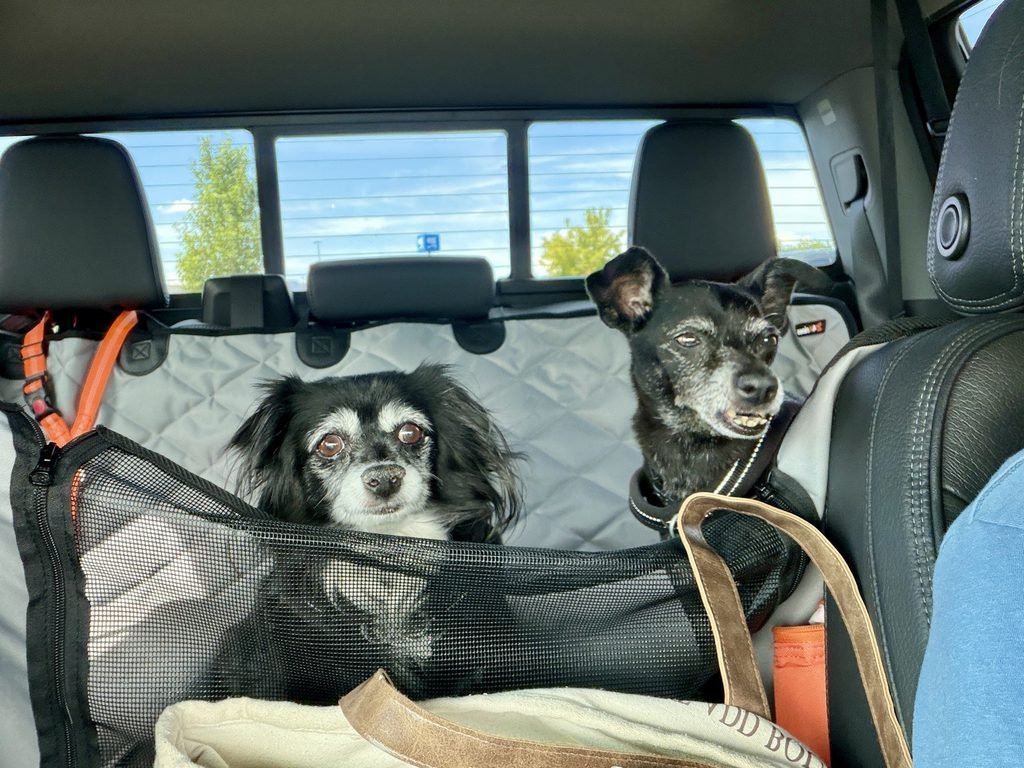
4Knines seat cover with cushion lift system — our truck setup for Loki and Gracie starts with a 4Knines seat cover protecting the back seat, with firmer cushions added on top to lift the dogs high enough to see out the windows comfortably. Small dogs in a standard back seat spend the whole drive staring at the back of the front seats. The lift gives them the view, which keeps them calmer and more engaged on long driving days. Leash tethers attach from the headrest to their harnesses, keeping them safely secured without restricting their ability to look around. It’s a setup we arrived at over time and wouldn’t travel without now.
Dog stroller — this one surprises people until they understand the logic. Patio dining with small dogs creates a constant management problem — dogs underfoot, other diners uncomfortable, the whole meal spent corralling rather than eating. The stroller solves it cleanly. Dogs go in, dogs are contained and comfortable, everyone eats in peace. Fat Racks BBQ’s dog-friendly patio was significantly easier with the stroller than it would have been without it. We use it more than we expected to and recommend it without hesitation for small dog travelers.
Collapsible water bowl — lives in every bag, every jacket pocket, the truck, and multiple locations in the RV. Dogs dehydrate faster than we notice and faster than they indicate. Water immediately available at every stop is not optional.
Marcell monitor — camera and temperature monitoring for the RV when we’re away. Essential for peace of mind, limited by cell service in remote areas, which is why it informs but doesn’t replace the decision to bring the dogs along on park days.
Medication organizer with a travel duplicate — Loki’s medications are organized by day and time with a backup set in a separate bag. Losing one set doesn’t mean losing both. This is the kind of redundancy that feels excessive until the moment it isn’t.
Dog first aid kit — basic wound care, Benadryl dosed for their weight confirmed by the vet, a copy of their medical records and vaccination history. In remote areas of Wyoming, the nearest veterinary clinic is not close. Preparation is proportional to remoteness.
Finding Genuinely Dog-Friendly Stops
There’s a difference between a stop that technically permits dogs and a stop that is genuinely good for them. Learning that difference has changed how we plan trips.
Technically permitted means dogs can be in the parking area. Genuinely good means dogs have room to move, shade available, water nearby, interesting terrain rather than hot asphalt.
On the Cody trip, genuinely good dog stops included Beck Lake Dog Park — fenced, with lake access for swimming, the single best dog infrastructure we found in the region. The Shoshone Riverway Trail and Paul Stock Nature Trail in Cody — flat, shaded, river-adjacent, long enough to matter. The Shoshone National Forest trailheads along the North Fork Highway — real trails, real terrain, dogs fully welcome on leash throughout.
Inside Yellowstone, the genuinely good dog experiences were the ones done from the truck — Lamar Valley wildlife watching with windows down, the East Entrance road at dawn, Hayden Valley bison from the roadside pullout. These weren’t compromises. They were good experiences that happened to be dog-compatible, which is a different thing.
The Bark Ranger program at national parks and federal recreation areas gives the dogs a tangible connection to every place we visit — a tag collected at the visitor center that becomes part of their record of where they’ve been. Loki and Gracie have more than seventy. The collection started as a small thing and became something we plan around.
What We’d Do Differently
If Loki’s health allowed it, we’d investigate dog daycare options near Cody before the trip. Having a trusted local facility for the days when the boardwalk experience is the priority — Old Faithful, the Grand Canyon of the Yellowstone, Norris Geyser Basin — would have given us more flexibility on those specific days. We tag-teamed instead, and it worked, but the honest answer is that daycare would have been easier on some days if it had been an option.
We’d also build in more dedicated dog days from the beginning rather than treating them as recovery days between park days. Beck Lake deserved more than one visit. The dogs were patient with our Yellowstone obsession. They deserved more days organized entirely around what they needed.
What They’ve Given Us
Loki and Gracie have limited some experiences. The boardwalk at Old Faithful required planning around them. The Grand Canyon of the Yellowstone required one of us to stay behind. There are places we didn’t go and things we didn’t see because two small dogs needed to be accounted for in the calculation.
They’ve also enriched experiences we wouldn’t have found otherwise. The Shoshone National Forest walks at dawn before driving into the park. The Shoshone Riverway at dusk when the canyon light was doing something extraordinary and we stopped walking to watch it. The Lamar Valley morning when Loki had his nose against the truck window watching a bison cross the road twenty yards away, his ears up and his whole body still with attention.
You don’t find those moments by planning them. You find them because you’re moving at the speed your dogs require, stopping when they need to stop, paying attention to what they’re paying attention to.
After seventy-plus tags, that’s what we know about traveling with dogs. They limit some things. They find others. The ones they find are usually better.
For planning a Yellowstone trip with dogs specifically, see our complete guide to traveling Yellowstone with dogs and dog-friendly Cody, Wyoming. For base camp logistics, see our RV road trip planning guide and Yellowstone Valley Inn RV Park review.

Angela DiLoreto is a bestselling author, former Fortune 500 marketing executive, and a passionate advocate who successfully worked to change stalking laws in several states after a family friend was murdered by her stalker. That fight — for justice, for voices that weren’t being heard, for stories that needed to be told — runs through everything she does. She and her husband Vince travel the country by RV with their two rescue chihuahuas, Gracie and Loki, chasing history, great food, and the overlooked people and places that shaped America. Angela created Fitting in Adventure and the Historic Footnotes series because the best stories are usually the ones nobody’s heard yet.