
Kennedy Space Center is a wildlife refuge.
Disclosure: Some links on our site are affiliate links. If you purchase a linked item, we will make a commission, at no extra charge to you.
That is not a metaphor. The 140,000 acres of federal land surrounding the launch facilities at Cape Canaveral constitute one of the largest undeveloped tracts on Florida’s Atlantic coast. The Merritt Island National Wildlife Refuge that occupies most of it hosts one of the highest concentrations of bald eagles in the eastern United States, along with manatees in the Indian River, dolphins in the turning basin, osprey nesting on infrastructure that also supports rocket launches, and more species of threatened and endangered wildlife than any other refuge in the continental United States.
The rockets launch anyway. The eagles fish anyway. The manatees move through the same waterways that support the barges carrying spacecraft components to the assembly building. This is not a contradiction that anyone on the Space Coast finds particularly remarkable. It is simply how things are here — the most advanced technology human beings have ever built coexisting with wilderness that existed long before the space program and will exist long after it, all on the same 35-mile stretch of Florida coastline.
The Space Coast has been this way since the 1950s, when the U.S. government looked at this remote, sparsely populated barrier island and decided it was the right place to launch rockets. The wildlife was already here. The space program moved in around it. Sixty-plus years later, neither has given ground.
The Launches: What It Actually Looks Like
Cape Canaveral and Kennedy Space Center launch approximately 60 to 70 rockets per year combined — roughly one per week on average, though the schedule clusters and gaps in ways that make some weeks busier than others. SpaceX Falcon 9 rockets carry the majority of launches now, with United Launch Alliance and other providers filling in the rest.
Each launch is different. The trajectory changes, the payload changes, the time of day changes, the atmospheric conditions change. No two look quite the same from the ground. But the crewed missions carry something the cargo launches don’t — the knowledge that there is a human being on that rocket, strapped in, watching the Earth fall away, seeing something that fewer people have seen than have climbed Everest. The weight of that is different. It lands differently when you watch it.
The Jellyfish Phenomenon
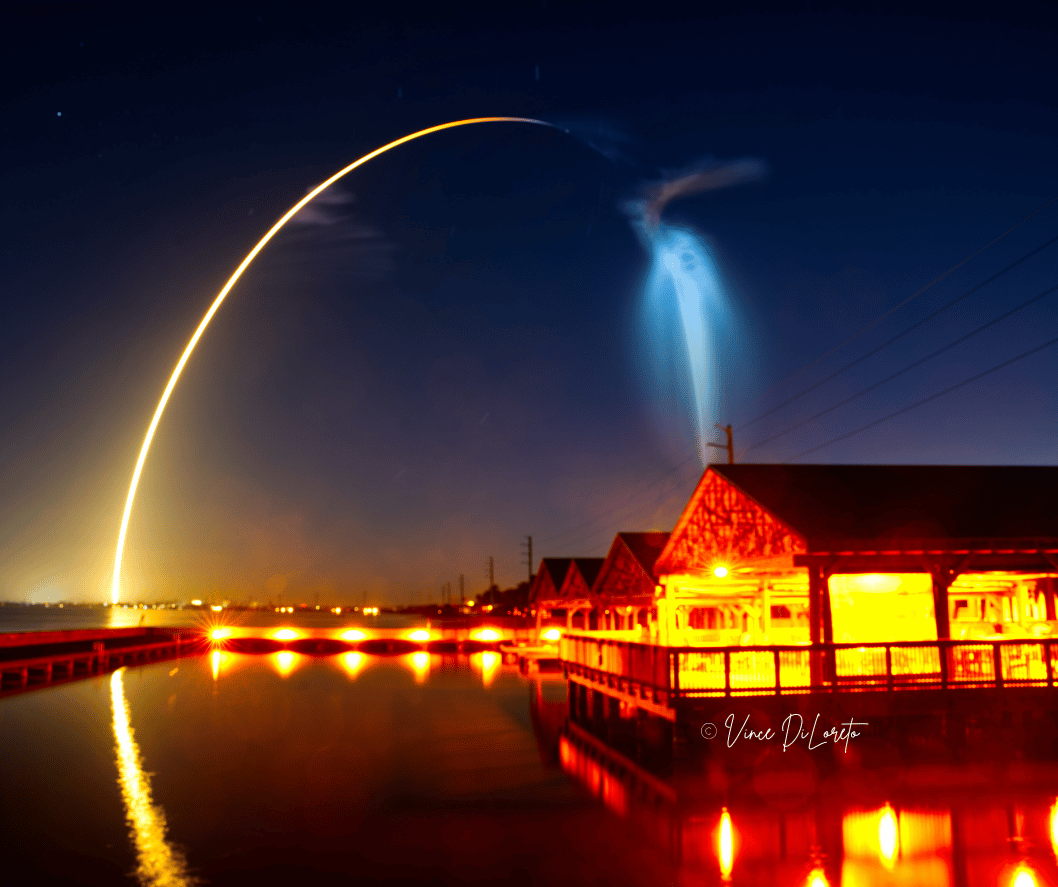
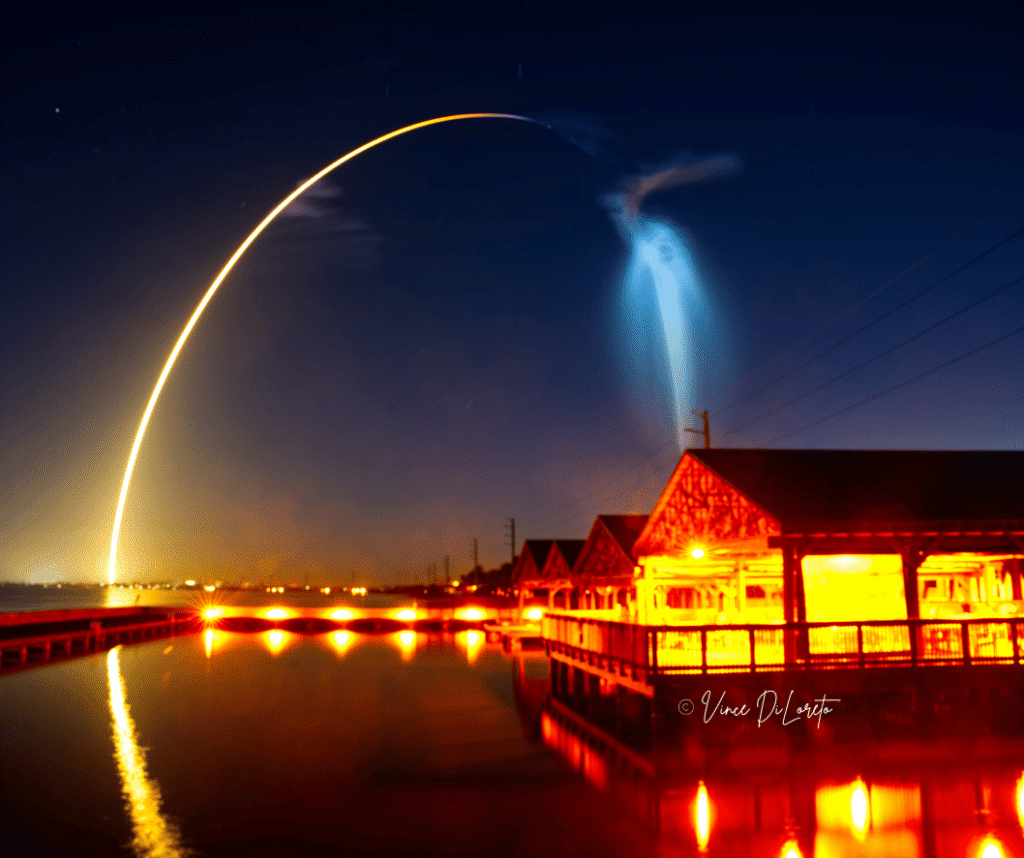
Night launches produce something that daytime launches cannot: the jellyfish.
As a rocket climbs through the upper atmosphere, its exhaust plume expands in the thinning air, spreading outward in a widening cone. At a certain altitude — typically between 60 and 80 miles up, in the mesosphere — the plume enters a region where sunlight reaches even when the sky below is dark. The exhaust ice crystals catch that high-altitude sunlight and scatter it, creating a glowing, translucent, spreading cloud that looks nothing like a rocket exhaust and exactly like a bioluminescent jellyfish expanding silently in the dark sky.
The phenomenon lasts only a few minutes before the plume disperses, and it doesn’t happen on every launch — the geometry of the rocket’s trajectory and the angle of the sun have to align. When it does happen, it stops people mid-sentence. It is one of those things that photographs don’t capture fully because the photographs can’t capture the silence, or the scale, or the fact that it’s happening live above your head.
Set the alarm. Go outside. Every launch is worth watching, and the ones that produce a jellyfish are worth losing sleep over.
Visiting Florida’s Space Coast: How to Watch Rocket Launches
What It’s Like to Attend a NASA Rocket Launch
Where to Watch a Launch
Space View Park in Titusville is the best free viewing location on the Space Coast. It sits on the western shore of the Indian River directly across from Kennedy Space Center, with unobstructed sightlines to the launch pads, a countdown clock, and speakers carrying the launch audio. For major launches — crewed missions especially — arrive two to three hours early. For routine Falcon 9 cargo launches, an hour is usually enough.
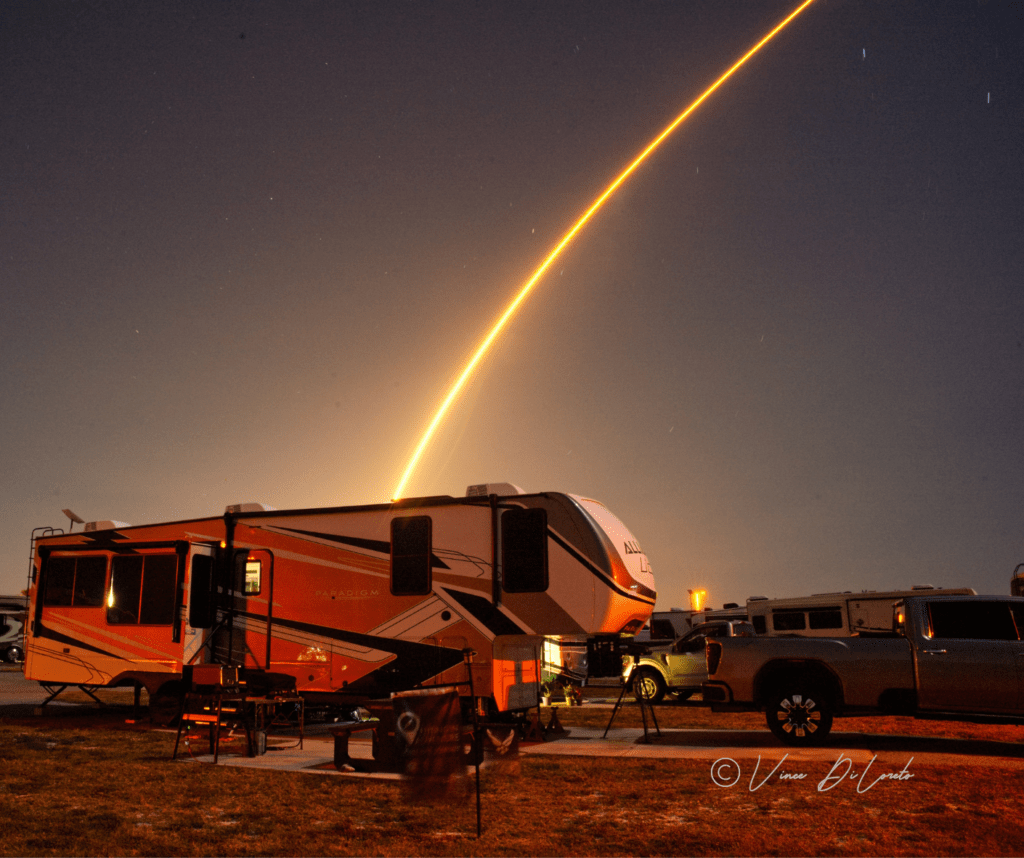
Jetty Park at Port Canaveral offers a closer view from the south and is popular for photography. The beaches along A1A in Cocoa Beach give a different angle. The Kennedy Space Center causeway requires a paid ticket but puts you closest of all to the pads.
The Space Launch Now app is the most reliable way to track the schedule and receive scrub notifications. Launch windows can be as short as 30 seconds, and scrubs happen — weather, technical issues, and range conflicts can cancel a launch at any point up to the final seconds of the countdown. If a launch scrubs, check the next available window immediately. They often try again within 24 hours.
Pro tip: Night launches are worth the alarm regardless of what time they’re scheduled. The jellyfish phenomenon only happens at night. Set the alarm.
Kennedy Space Center: The History in the Hardware
Kennedy Space Center Visitor Complex tells the history of American human spaceflight through the actual hardware — not replicas, the real vehicles — and that distinction matters more than it sounds. Standing beneath the F-1 engines of the Saturn V rocket in the Saturn V Center is a different experience than standing beneath a replica of them. The engines that burned 20,000 pounds of propellant per second and lifted 6.5 million pounds off the ground are right there. The scale is something that has to be encountered in person.
The Saturn V Center is the essential stop. The rocket is displayed horizontally in a building built specifically for it — 363 feet of the most powerful machine ever built by human beings, close enough to touch at certain points. The Apollo 1 memorial at the entrance, honoring Gus Grissom, Ed White, and Roger Chaffee who died in the launch pad fire of 1967, sets the register for everything that follows. The space program cost things. The Saturn V Center doesn’t let you forget that while you’re marveling at what it achieved.
Space Shuttle Atlantis is the other essential stop. Suspended as if in orbit, tilted at the angle it flew, payload bay open, surrounded by immersive displays covering 30 years of shuttle history — it is one of the finest single-exhibit experiences in American museum culture. Plan a full day for Kennedy Space Center. A half-day visit means leaving things out.
Kennedy Space Center: Space Exploration History & Future
The Valiant Air Command Warbird Museum

The Warbird Museum in Titusville is one of those places that rewards visitors who weren’t specifically looking for it. The collection focuses on World War II-era aircraft — all of them airworthy, most of them flown — including a B-17 Flying Fortress, a B-25 Mitchell, and a P-51 Mustang. What distinguishes it from larger aviation collections is its human scale: the volunteers and staff know the individual histories of the planes, the mechanics are often visible working on the aircraft, and the annual Thunder Over Titusville airshow brings everything out of the hangar and into the air.
The through-line from the Warbird Museum to Kennedy Space Center is shorter than it looks. Many of the engineers and designers who built the space program came directly from the aviation industry that produced these aircraft. The B-17 and the Saturn V are separated by two decades and an almost incomprehensible leap in capability, but they come from the same American engineering tradition.
Warbird Museum Titusville: A Must-Visit for Aviation History
The People Behind the Program
The Space Coast’s history includes stories that the official accounts have historically undercounted. Judith Love Cohen was an aerospace engineer who worked on the Apollo program’s Abort Guidance System — the system that would have returned the Apollo 13 crew to Earth if the primary guidance computer had failed. She went into labor with her son on the day of the Apollo 13 crisis, brought her work to the hospital, completed the calculations before delivering, and returned to work shortly after. Her son was Jack Black.
Cohen spent her later years writing children’s books about women in science and engineering. Her story is one of many that belong in the Space Coast’s history and have only recently begun receiving the recognition they deserve. The program that put humans on the Moon was built by thousands of people whose names are not on the rockets.
The Unsung Hero of Apollo 13: Judith Love Cohen
The Wildlife: The Other Reason to Be Here
The Merritt Island National Wildlife Refuge wraps around Kennedy Space Center on three sides and is one of the finest birding destinations in Florida. The Black Point Wildlife Drive — a seven-mile loop through freshwater impoundments, saltwater flats, and scrub habitat — is one of the best wildlife drives in the state. Bald eagles are common. Roseate spoonbills, wood storks, and dozens of species of shorebirds use the impoundments. Manatees are visible in the Indian River from October through March.
Canaveral National Seashore, north of the Space Center, protects 24 miles of undeveloped Atlantic coastline — among the longest undeveloped stretches on Florida’s east coast. Playalinda Beach, the southernmost section, is the closest public beach to the launch pads and one of the few places where you can watch a launch from the beach itself on authorized viewing days.
The convergence of these two things — the wilderness and the technology — is what defines the Space Coast. Watching an osprey fish in the Indian River with a launch pad visible across the water is a genuinely Space Coast experience, and it doesn’t happen anywhere else.
What to Know Before You Go
Best base: Titusville for launch viewing and the Warbird Museum. Cocoa Beach for beaches and nightlife. Both are within 30 minutes of Kennedy Space Center.
How to track launches: Download Space Launch Now app and enable push notifications. Check NASA and SpaceX social media for updates. Scrubs happen — always check for the next window.
Kennedy Space Center: Plan a full day. Buy tickets online in advance. The Saturn V Center and Atlantis exhibit are both essential.
Wildlife refuge: Black Point Wildlife Drive is free and open dawn to dusk. Bring binoculars. Best birding is October through April.
Night launches: Set the alarm. Go outside. Watch for the jellyfish. You will not regret it.
Frequently Asked Questions About Florida’s Space Coast
Where is the best place to watch a rocket launch on the Space Coast?
Space View Park in Titusville is the best free rocket launch viewing location on the Space Coast. It sits directly across the Indian River from Kennedy Space Center with unobstructed sightlines, a countdown clock, and launch audio. Arrive two to three hours early for crewed missions, one hour for routine cargo launches.
What is the jellyfish phenomenon during a rocket launch?
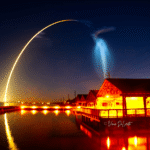
The jellyfish phenomenon occurs during night launches when a rocket’s exhaust plume reaches the upper atmosphere — typically between 60 and 80 miles up — where sunlight reaches even when the sky below is dark. The exhaust ice crystals catch high-altitude sunlight and scatter it, creating a glowing, translucent, expanding cloud that resembles a jellyfish. The effect lasts only a few minutes and depends on the trajectory and sun angle aligning correctly.
Is Kennedy Space Center worth visiting?
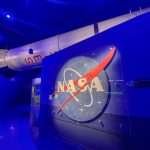
Yes. Kennedy Space Center Visitor Complex is one of the finest science and history museums in the United States. The Saturn V Center — featuring the actual 363-foot Moon rocket displayed horizontally — and the Space Shuttle Atlantis exhibit are both essential. Plan a full day.
How often do rockets launch from Cape Canaveral?
Cape Canaveral and Kennedy Space Center combined launch approximately 100 rockets per year. SpaceX Falcon 9 rockets carry the majority of launches. Schedules are published in advance but subject to scrubs due to weather and technical issues — the Space Launch Now app provides the most reliable real-time updates.
Is Kennedy Space Center a wildlife refuge?
Yes. The 140,000 acres of federal land surrounding the launch facilities at Cape Canaveral constitute the Merritt Island National Wildlife Refuge, one of the most biodiverse refuges in the continental United States. It hosts bald eagles, manatees, dolphins, roseate spoonbills, and more than 330 species of birds, coexisting with the space program on the same stretch of Florida coastline.
Explore Florida’s Space Coast with Fitting in Adventure
How to Watch Rocket Launches on Florida’s Space Coast
What It’s Like to Attend a NASA Rocket Launch
Kennedy Space Center: Space Exploration History & Future
The Sands Space History Center
Cape Canaveral Lighthouse & Space History
The Unsung Hero of Apollo 13: Judith Love Cohen
A Journey Through Time on Florida’s Space Coast
Titusville’s National Police Memorial

Angela DiLoreto is a bestselling author, former Fortune 500 marketing executive, and a passionate advocate who successfully worked to change stalking laws in several states after a family friend was murdered by her stalker. That fight — for justice, for voices that weren’t being heard, for stories that needed to be told — runs through everything she does. She and her husband Vince travel the country by RV with their two rescue chihuahuas, Gracie and Loki, chasing history, great food, and the overlooked people and places that shaped America. Angela created Fitting in Adventure and the Historic Footnotes series because the best stories are usually the ones nobody’s heard yet.