
When most people think of early American history, they imagine the Revolution or the Civil War. But tucked into the rolling hills of Pennsylvania is the story of a lesser-known uprising that tested the authority of the brand-new United States: the Whiskey Rebellion. Visiting Washington County today lets you step back into the 1790s, when farmers, distillers, and federal troops clashed over taxes, independence, and the future of the republic.
Disclosure: Some links on our site are affiliate links. If you purchase a linked item, we will make a commission, at no extra charge to you.
A Brief History of the Whiskey Rebellion
The newly formed United States government, under the leadership of President George Washington, faced one of its first significant domestic challenges in 1791 with the imposition of a federal excise tax on distilled spirits. This tax, a cornerstone of Treasury Secretary Alexander Hamilton’s financial plan to pay off the nation’s Revolutionary War debt, was met with fierce opposition, particularly in the western frontier regions.
For farmers in western Pennsylvania and other frontier settlements, whiskey was far more than just an alcoholic beverage. It served as a crucial form of currency, a readily transportable and valuable commodity that could be traded for goods and services in an economy where hard currency was scarce. Excess grain, difficult and costly to transport over long distances to eastern markets, was often distilled into whiskey, significantly increasing its value and shelf life. Thus, the tax directly impacted their livelihoods, hitting them disproportionately harder than the larger, more established distillers in the East who had better access to markets and capital.
The anger and resentment among these agrarian communities quickly coalesced into organized resistance. From 1791 to 1794, protests escalated. Farmers and distillers in western Pennsylvania, feeling their economic survival threatened and their voices unheard by a distant federal government, began to actively defy tax collectors. These early acts of defiance included intimidation, harassment, and the refusal to pay the tax.
By the summer of 1794, the situation had deteriorated into open violence. Tax collectors, seen as symbols of federal overreach, were increasingly targeted. Homes were burned, individuals were threatened, and some were even tarred and feathered, a brutal form of public humiliation and punishment. The intensity of the rebellion grew to such an extent that it directly challenged the authority and legitimacy of the nascent federal government.
In response to this threat to national unity and order, President George Washington made the unprecedented decision to personally lead a militia force of nearly 13,000 troops into western Pennsylvania. This extraordinary act marked the first and only time a sitting U.S. president has commanded an army in the field. The sheer display of federal power, coupled with the clear message that defiance of federal law would not be tolerated, effectively quashed the rebellion. While there was no major pitched battle, the overwhelming show of force dispersed the insurgents, and many of the ringleaders were eventually arrested.
Although the Whiskey Rebellion fizzled out without a large-scale armed confrontation, its significance in American history is profound. It served as a defining moment for the young republic, firmly establishing the federal government’s authority to enforce its laws and maintain domestic order. It demonstrated that the new Constitution, unlike the Articles of Confederation, provided a strong enough central government to quell internal insurrections. However, the event also left deep scars on the frontier communities, who felt betrayed by the very leaders they had fought to support during the American Revolution. Many viewed the government’s response as an oppressive act, further solidifying a divide between federal power and the individual liberties of its citizens, a tension that would continue to shape American political discourse for decades to come.
Ways to Experience the Whiskey Rebellion
If you want to go beyond the history books, Washington County offers immersive ways to experience the story of the Whiskey Rebellion.
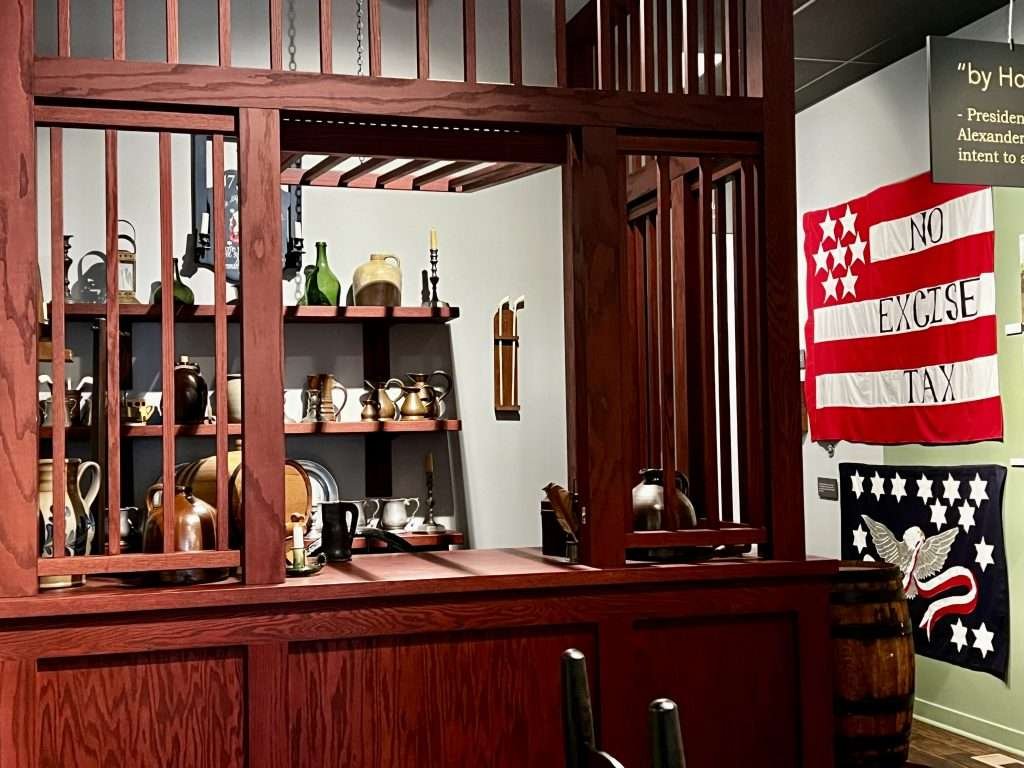
The Whiskey Rebellion Education and Visitor Center in Washington, PA, is the best starting point. It isn’t just a place to pick up brochures—it’s designed to set the stage for the rebellion’s story. Through interactive exhibits, maps, and period artifacts, visitors can see how ordinary farmers were caught in the crossfire of early American politics. By laying out the tensions between federal authority and frontier independence, the center gives context that deepens the rest of your exploration.
From there, the Whiskey Rebellion Trail offers a modern-day journey through the same landscapes where this early test of federal power once unfolded. Stretching across Pennsylvania, Maryland, Washington D.C., and Virginia, the trail links together distilleries, museums, and historic sites that tell both sides of the rebellion’s story—the struggles of farmers and the rise of American whiskey as an industry. Each stop isn’t just about tasting spirits or looking at displays; it’s about understanding how a grassroots protest shaped the culture and economy of a young nation.
Walking through these places, you get more than facts—you get a sense of what it felt like to live in a country still deciding what it stood for, and what freedoms were worth fighting for.
Whiskey Rebellion FAQs
Where did the Whiskey Rebellion happen?
The rebellion was centered in western Pennsylvania, particularly in Washington and Allegheny counties.
Why was whiskey taxed in the first place?
The federal government needed revenue to pay off Revolutionary War debt, and whiskey seemed like a profitable target. Unfortunately, it placed the greatest burden on small frontier farmers.