
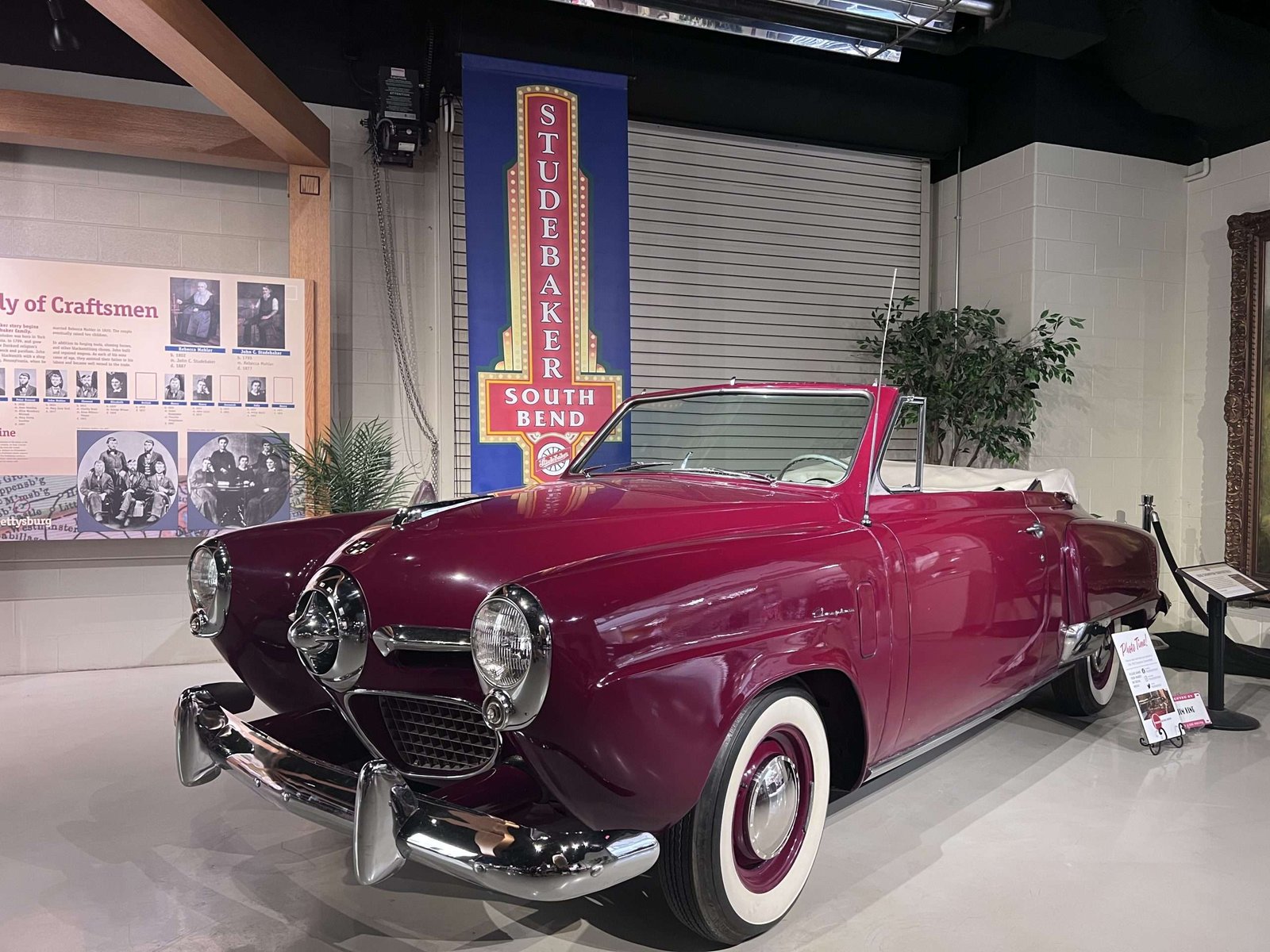
There’s something about old cars that stirs the imagination. Maybe it’s the gleaming chrome, the way the headlights resemble eyes peering into history, or how a single vehicle can transport you not just down the road, but back in time. If you’ve ever found yourself lingering over a vintage car in a parade or a weathered photo of the open road, visiting the Studebaker Museum in South Bend, IN belongs on your travel list.
Disclosure: Some links on our site are affiliate links. If you purchase a linked item, we will make a commission, at no extra charge to you.
On a recent Midwest road trip, we made an unplanned stop at the Studebaker Museum. I’ll admit — I’m not what you’d call a car fanatic. But we do love a good story, and it turns out that the story of Studebaker isn’t just about cars; it’s about America itself. This museum doesn’t feel like a sterile, glass-cased archive. It feels like a conversation, a living memory of a company that helped shape everything from the American Civil War to the birth of the suburban family road trip.
Whether you’re a history buff, a classic car lover, or just someone looking for a unique and surprisingly personal piece of Americana, here’s what you need to know about visiting the Studebaker Museum in South Bend, IN.

Before Studebaker was turning out sleek sedans and chrome-draped coupes, it was a humble wagon company. In 1852, brothers Henry and Clement Studebaker opened a blacksmith shop in South Bend, Indiana, producing sturdy wagons for farmers, miners, and pioneers heading west. By the mid-19th century, their wagons weren’t just local fixtures — they were rolling along frontier trails, military supply lines, and even carrying Abraham Lincoln’s presidential carriage.
Studebaker’s big break came during the Civil War when it supplied wagons to the Union Army. These vehicles were built for brutal conditions: thick wooden wheels, reinforced undercarriages, and smart, practical designs made them invaluable in moving troops and supplies. That reputation for reliability stuck with the brand for over a century.
As the 20th century dawned, the automotive age took off — and while many wagon makers stubbornly clung to horses, Studebaker adapted. In 1902, it released its first electric car. Yes, electric — decades before Elon Musk’s parents were even born. While it wasn’t commercially dominant, it proved Studebaker’s willingness to experiment with new technology.

By 1904, Studebaker was producing gasoline-powered cars, and over the next several decades, it built a reputation for bold, distinctive designs and forward-thinking engineering. Studebaker vehicles weren’t just modes of transportation; they were reflections of American style, optimism, and ingenuity.
Some of the standout models you’ll encounter in the museum — and worth knowing about — include:
- The 1950 Studebaker Champion Starlight Coupe
Possibly one of the most visually striking cars of its era, thanks to its wraparound rear window that gave it a jet-age, spaceship-like look. It was one of the first American cars to lean into that “futuristic” post-war optimism on four wheels. - The Studebaker Avanti (1962–1963)
This was Studebaker’s Hail Mary — a sleek, fiberglass-bodied performance coupe designed to challenge European sports cars and appeal to a younger, thrill-seeking market. The Avanti could hit 170 mph on the Bonneville Salt Flats, making it one of the fastest production cars in the world at the time. It was innovative, ambitious, and in many ways, ahead of its time — a theme that became a bittersweet hallmark of the company. - The Studebaker Lark (1959–1966)
One of the earliest “compact” cars to challenge Detroit’s bloated sedans of the 1950s. The Lark was affordable, practical, and nimble, arriving just as Americans started to consider downsizing their daily drivers. - The President Series (1920s–1930s)
The President was Studebaker’s luxury line — a full-size, high-end car that could stand toe-to-toe with Packards and Cadillacs. These cars featured elegant designs, chrome-laden grilles, and powerful straight-eight engines. They weren’t just vehicles; they were status symbols.

Studebaker didn’t just build good-looking cars — it introduced engineering features years ahead of its competitors. They were among the first to use automatic transmissions, hill-holding clutches, and innovative safety features like recessed dashboards to reduce injury in a crash. Their focus on combining style with practical innovation earned them a fiercely loyal following, particularly in the Midwest.
But like many American manufacturers, Studebaker struggled in the wake of WWII. Competing with the Big Three (Ford, GM, and Chrysler) became increasingly difficult, especially as those giants scaled production and undercut prices. Studebaker tried to fight back with bold new designs — the bullet-nose front of the 1950–51 Champion is iconic in its own right — but financial pressures mounted.
The company officially ceased American auto production in 1963 and shuttered its Canadian plant in 1966. Even so, Studebaker left behind a legacy of risk-taking, ahead-of-its-time ideas, and automotive craftsmanship that enthusiasts still celebrate today.
That’s where the museum comes in. Recognizing the historical significance, local car collectors, former employees, and city leaders rallied to preserve Studebaker’s story. The Studebaker National Museum officially opened its current, purpose-built location in 2005 and today houses one of the most comprehensive collections of vehicles, prototypes, memorabilia, and archives from a single American manufacturer.

Visiting the Studebaker Museum in South Bend, IN isn’t just about appreciating old cars; it’s about tracing the story of American ambition on wheels. It’s a reminder of how a small Midwestern wagon shop grew into an industrial giant, played a part in wars and cultural trends, pioneered electric cars long before it was cool, and left a legacy still driving down memory lane.
Whether you’re a lifelong car lover or someone who couldn’t tell a tailpipe from a driveshaft, it’s hard not to walk out of this museum without a new appreciation for the grit and creativity that once fueled America’s automotive heartland.
Is parking available at the Studebaker Museum?
Yes, the museum offers free on-site parking, including spaces for RVs and buses.
How long should I plan for my visit?

Plan for 2–3 hours to comfortably explore the entire museum, including reading exhibit signage and watching any available short films.
Is the museum kid-friendly?

Absolutely. While some young children may lose interest in the historical displays, there are interactive elements and family-friendly programs held throughout the year.
Can I take photos inside the museum?

Yes, photography is allowed for personal use. Flash photography and tripods are typically restricted.
What’s included in the combo ticket with The History Museum?
The combo ticket grants you admission to both the Studebaker Museum and The History Museum, including a guided tour of the Oliver Mansion if available.
Is there a gift shop?
Yes, and it’s surprisingly good. In addition to the expected branded mugs and model cars, you’ll find unique books, vintage-style signs, and local-made candies.