

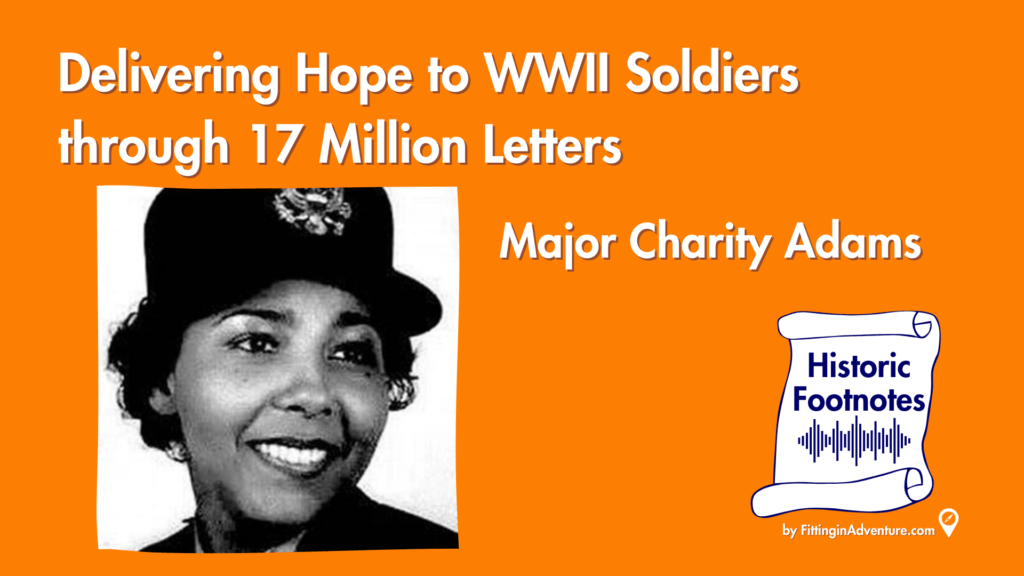
Major Charity Adams and the 6888th: The Women Who Delivered the War
Picture this: it’s 1945 and soldiers on the frontlines eagerly await a letter from their loved ones back home. But their letters are undelivered, stuck in a backlog of over 17 million pieces of mail. Enter Major Charity Adams, a trailblazing African-American woman who led the all-black, all-female 6888th Central Postal Directory Battalion to clear that massive backlog and boost the morale of soldiers fighting for our country.
Disclosure: Some links on our site are affiliate links. If you purchase a linked item, we will make a commission, at no extra charge to you.
Born in Columbia, South Carolina in 1918, Adams was one of only a few black women accepted into the Women’s Army Auxiliary Corps, which later became the Women’s Army Corps. Her impressive leadership skills quickly caught the eye of her superiors, and she was later commissioned as the corps’ first black woman officer and the first to command a battalion of black women.
But it wasn’t all smooth sailing for Adams and her battalion. They faced the double burden of racial segregation and gender discrimination in the wartime Army — Black women who had enlisted to serve their country were assigned to separate facilities, given inferior equipment, and frequently questioned by white male officers who doubted their capabilities. At one point, a white general arrived at their facility and threatened to replace them with men. Adams reportedly walked up to him and said, “Over my dead body, sir.” He left. The women stayed.
The conditions in Birmingham, England — where the battalion was stationed — were harsh. The warehouse where they worked was cold and damp, with no running water or adequate heating. The mail itself was a logistical nightmare: millions of pieces misdirected, misaddressed, or simply piled up with no system for sorting. Some letters had been sitting undelivered for years. Soldiers at the front had given up hope of hearing from home.
The 6888th Central Postal Directory Battalion became a beacon of hope for soldiers waiting for their letters. Adams led a team of highly skilled women experts in typing and stenography who were recruited from all over the United States. They worked tirelessly, often in cold, damp conditions with no running water or heat. Despite these challenging circumstances, the women worked around the clock, 8-10 hours a day, 7 days a week. In just a few months, they cleared through all 17 million pieces of mail, improving the efficiency of the postal service and giving soldiers the boost they needed.
Adams continued to serve in the military after the war, rising to the rank of lieutenant colonel. She was a fierce advocate for women’s and civil rights, using her position to improve opportunities for women and African Americans in the military and beyond. Her incredible achievements were recognized in 1996 when she was posthumously inducted into the Military Intelligence Hall of Fame.
Why 17 Million Letters Mattered
In an era before phone calls were routine and international communication was measured in weeks rather than seconds, a letter from home was everything. Studies conducted by the Army during WWII consistently found that mail from family was the single most important factor in maintaining soldier morale — ahead of food, pay, and leave. A soldier who stopped receiving letters was considered at serious risk of psychological breakdown. Commanders reported that units with reliable mail delivery fought more effectively than those without it.
The 6888th understood this. They worked in three shifts around the clock, eight hours per day, seven days a week. They developed their own sorting system to tackle the backlog — cross-referencing names, serial numbers, and unit assignments to find where each piece of mail needed to go. They cleared the entire 17-million-piece backlog in three months, roughly half the time the Army had allotted. Then they moved on to clear backlogs in Paris and Rouen.
Recognition — Long Overdue
The 6888th Central Postal Directory Battalion was deactivated in 1946. For decades, their story was largely unknown outside military history circles. Major Charity Adams’ 1996 induction into the Military Intelligence Hall of Fame was a rare acknowledgment of what the battalion had accomplished.
The fuller recognition came much later. In 2022, Congress awarded the 6888th Central Postal Directory Battalion the Congressional Gold Medal — one of the highest civilian honors the United States can bestow. By that time, most of the women who had served in the battalion had died. The few survivors who attended the ceremony were in their nineties.
In 2024, a statue of Major Charity Adams was unveiled in her hometown of Columbia, South Carolina. She stands in bronze in full uniform, the first statue of a Black woman in the state’s capital city.
The 17 million letters got delivered. It took the country considerably longer to deliver its gratitude.

Angela DiLoreto is a bestselling author, former Fortune 500 marketing executive, and a passionate advocate who successfully worked to change stalking laws in several states after a family friend was murdered by her stalker. That fight — for justice, for voices that weren’t being heard, for stories that needed to be told — runs through everything she does. She and her husband Vince travel the country by RV with their two rescue chihuahuas, Gracie and Loki, chasing history, great food, and the overlooked people and places that shaped America. Angela created Fitting in Adventure and the Historic Footnotes series because the best stories are usually the ones nobody’s heard yet.